An artists journey

Author: eoschlotz

  • The Paint is Never Dry

    The Paint is Never Dry

    I find there are 2 categories of images in my library: ones I am “done” with and ones I want to tweak each time I open the file. Furthermore, it seems the ones I want to do something to each time I see them are the ones I like best. I refer to this as the paint being never dry.

    A significant advantage of digital image manipulation is that it is so easy to make changes. This can also be a problem.

    Wet paint

    Modern technology gives us great freedom to edit and express ourselves. It is so easy to make some changes every time we open the file. Oh, I didn’t see that little flaw. I really don’t like the relation of these tones now that I look at it again. Maybe it would have more punch if I pumped some of these colors some.

    But this is a subtle trap. A trap of time, because this is a never ending treadmill of editing, and of lack of confidence. I will write about this confidence problem in the future. Basically, it has been hard to accept that, as an artist, no one can tell me what is “right” or when I am “done”. I am the only one who can decide.

    Prints

    I wrote once about prints being a frozen moment in time. This is one of the great things about prints. They are not changeable.

    A print represents my interpretation of the image at one moment in time. It is very tempting for me to modify it a little every time I print it. But now that I do editions of prints, I have to discipline myself to create exact duplicates for each print in the edition. It would be dishonest and a disservice to the purchasers if each one was different.

    Part of the process of growth is deciding that an image is “done” and is ready to be shown and purchased . And I have to be able to stand proudly and represent it as my art, that I am proud of, even if I see opportunities for improvement.

    Creative vision

    But my creative vision is evolving all the time. It is frustrating to be locked in to printing a series a certain way when I may see it different now. I am resolved, though, that that is the requirement. I will have to exercise my creativity on new images.

    The images are my children, in a sense. But any parent finds out that after they grow up, you have to let them go. Send them on their way to be independent. I can no longer control them or manage them. Kind of the same with my images. When one is sold, the whole edition is frozen, out of my control.

    Oh, but the new images, the ones that haven’t sold yet. They are free to be interpreted and re-interpreted at will. I love to do this, but I recognize the need to let the paint dry at some point.

    As the artist, all my images are resources to me to use any way I wish. Even the editioned ones can be recycled by compositing, over-painting, or radical cropping. Anything that makes it into a whole new work of art. My creative vision can best be applied to new work rather than reworking old things.

    Growth

    I don’t believe doing a great image “uses me up”. I have to believe I have a boundless well of creativity. It is better to go out and create new work. Learn what I can from the best of what I have done and go on from there. Explore a theme and do variations. Discover new themes.

    My curiosity will lead me to new subjects, new visions for old ones, new points of view. I will learn new techniques for shooting and processing.

    It would be devastating to feel that my best work is already done. I would have to quit if that were the case. I feel sorry for the old rock bands who still tour. No one wants to hear their new work. They only want to hear the hits of 40 years ago. They are trapped. I couldn’t do it.

    So, yes, my tendency is to want to constantly rework and tweak everything. I often see things I would change in my work. But discipline has to be applied. Most old work should be left as a memory and a signpost along the way of my journey. Apply the creativity to the new images. Let the paint dry.

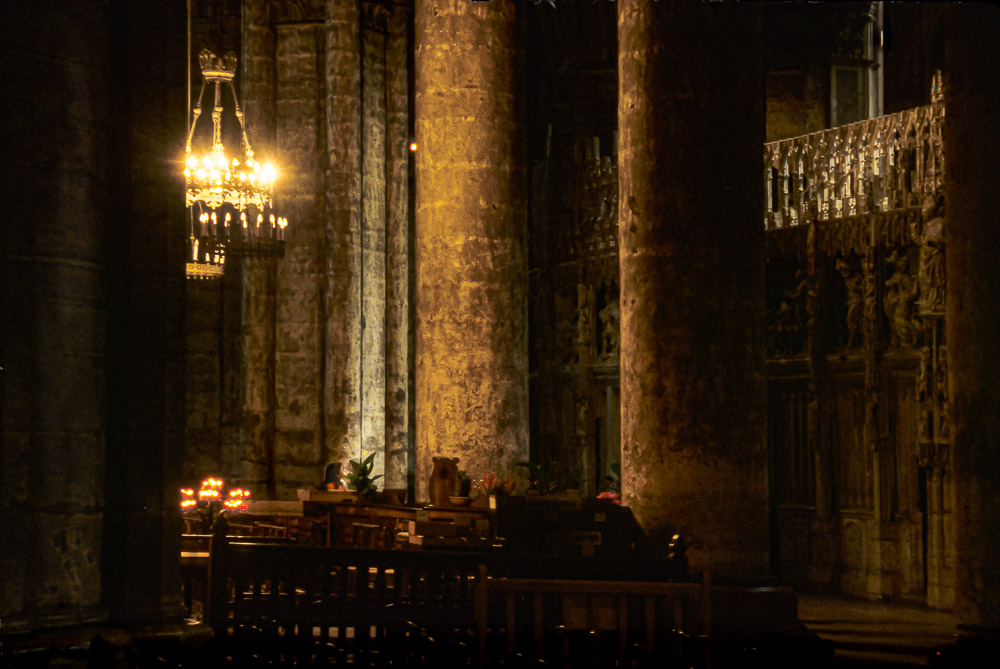
    A confession: even after writing all this about letting the paint dry, I went back and did some minor edits on the image with this article. This is an old image, scanned from film. The quality is not up to today’s standards. But I really like the feeling of the image and the memories it brings back of Chartres Cathedral in France. So I indulged myself in one more little tweak. Do what I say, not what I do.

  • Is It Interesting, Part 2

    Is It Interesting, Part 2

    In the first part of this I made a point I learned from a book on poetry, that if it isn’t interesting, no one will read it. It doesn’t matter how formally structured or well composed it is. More and more I am coming to believe this is true for most art, too. But how do we get from boring to interesting?

    Familiarity

    It is conventional wisdom that you do your best work in an area you are familiar with. I sort of believe this, but I violate it all the time. Being an explorer nature I get a lot of energy out of photographing in new areas. Things seem fresh and waiting to be discovered. I get really psyched in interesting new places.

    I am getting enough experience to see the other side, too. Yes, having familiar places can help us to make more interesting images. We learn the range of possibilities. We see the variations with seasons and weather and light. Familiar subjects give us an opportunity to pick and choose. To wait for the best conditions without having to feel rushed because this is the only time we will see this location.

    Once we become well acquainted with an area we can develop a more sophisticated view of it. We won’t waste our time on shots that have little hope of being good. This is a progression to shooting more interesting images.

    I do not feel this is an absolute. That is, it is incorrect to take it to the extreme and sat you will only get interesting images of areas you are familiar with. But I do agree that familiarity probably makes it easier.

    Recording

    Most of us have a progression we go through. We start out making record shots of places we visit. Of the billions of photos taken every day most are record shots or selfies. Have you ever gotten stuck being forced to watch 2000 pictures of someone’s trip to Disney World? Just shoot me.

    I call this taking pictures “of” something. We are recording the superficial. We have not formed a refined artistic opinion of the subject. This is still operating at the “oooh, pretty; I will take a picture of it” level.

    If you follow this blog you probably do a much better job than average. Our record shots can be well composed and exposed. They are decent images. But mostly they are there to record an event that will trigger a memory for us. That doesn’t make them very interesting to other people.

    I’m not being critical, really. We all react this way when we see a new thing that captures our interest.

    Interpreting

    After we get over the initial excitement of a great new location, we can start to examine what we are being drawn to. We become more aware of our feelings and perceptions. Now we can peel back some of the superficial and uncover deeper aspects of the subject.

    I call this taking pictures “about” something. It reveals to our viewers a new side of the subject or our emotional reaction to it. We are giving an interpretation of what we see. These images are probably more appealing than simple record shots.

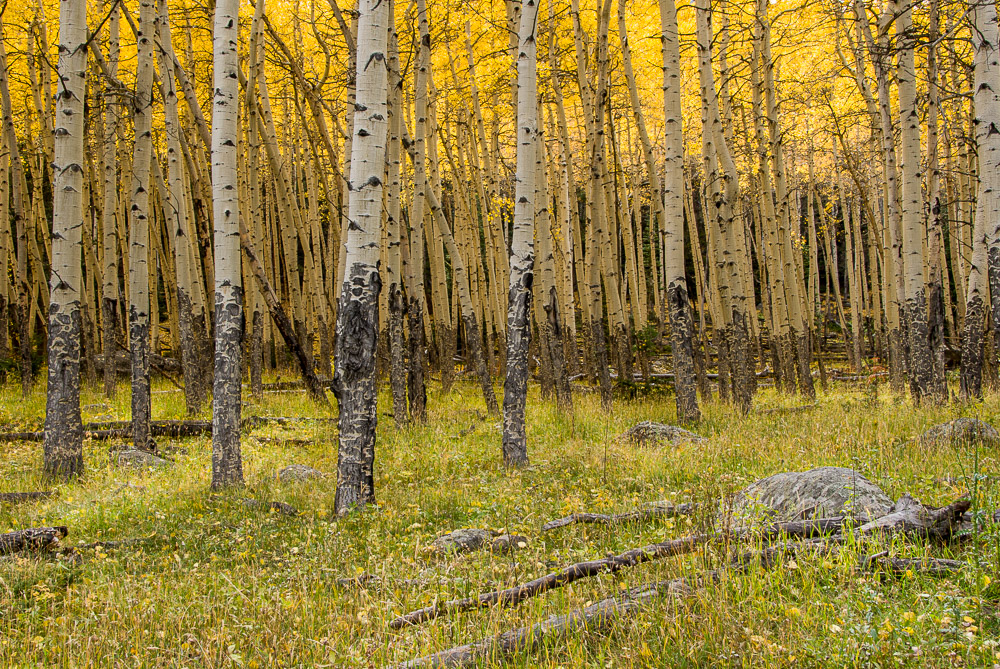
    Being intimately familiar with a location or a subject does make this easier. Take trees as an example. I have aspen trees where I live. If I didn’t know them well, the first time I saw them I would get a “wow, an aspen tree” shot. After having seen thousands of them in all conditions I have a much more focused appreciation of them. There are far fewer situations where I will capture an image, because I look for certain compositions that appeal to me.

    Hopefully I now make images about aspens, not just of them. Because I appreciate them more, I shoot them more selectively.

    Saying something

    At this point, we have figured out what attracts us about the subject. We have refined our emotional attraction to the subject to the point we know what we want to represent to viewers. Now we can bring our creativity in to allow us to synthesize an interesting image based on our vision. This is above and beyond just our emotional reaction.

    To continue the aspen example, it is the difference between “I like aspen trees because” and “here is a fresh and interesting image; it happens to be of an aspen”.

    Unfortunately, I have to give up the description of what makes an interesting image. I don’t have the knowledge or the vocabulary to be able to quantify it. Actually, I don’t think it is possible to do it.

    Thousands of tutorials and books are out there to teach us how to become better photographers. They can help boost us from the taking pictures “of” to taking pictures “about”. We can study vast amounts of description about composition and gestalt psychology and eye movement and contrast and lighting and color harmony and art history and … All of this is extremely valuable and should be studied.

    I don’t think it is possible for any of the training to give us the secret of making an interesting image. It is too complex and subjective and personal. I sincerely hope it cannot be quantified. If it is ever reduced to a formula then there will be no room left for artistic vision.

    Vision

    At the end, artistic vision is the secret ingredient that creates interesting images. You develop it through your training and experience and self examination. It is unique to an individual. No two of us will have the exact same vision.

    People may not like your vision. It may not be popular – remember, van Gogh never sold a painting in his lifetime. But what emerges is your vision. Embrace it and develop it. Use it to make unique and wonderful images.

    Familiarity with an area or a subject probably helps speed the process. I do not believe it is a requirement. If it were, it would be foolish for me to go to any new locations to try to make images. I do not believe that. Once we have developed our artistic vision I believe we can quickly apply it it new situations.

    Example

    Since I do not know how to describe the details of what happens, I will give some examples. I love the Trail Ridge Road area in Rocky Mountain National Park. I am a frequent visitor there. It resonates with me and I have refined my view of it a lot over the years.

    I give 3 examples here of that progression. The first was taken many years ago. It is a picture “of” Trail Ridge Road.

    Image “of” Trail Ridge Road

    This next image was shot years later. I have a much different feel for Trail Ridge Road. This captures much more of my emotional reaction to it. Notice that here the road is less visible and important than the setting.

    Image “about” Trail Ridge Road

    Finally, the image at the head of this article is a very recent interpretation. I feel I am getting down to the essence of Trail Ridge Road and, I hope, it is interesting also.

    The first time, I usually skim off the outer layer and end up with photographs that are fairly obvious. The second time, I have to look a little deeper. The images get more interesting. The third time it is even more challenging and on each subsequent occasion, the images should get stronger, but it takes more effort to get them.” – Michael Kenna

  • Is It Interesting?

    Is It Interesting?

    I find myself pondering this question a lot these days. More and more I believe the answer to “is it interesting?” overrides many considerations of composition and technique. This is a personal judgment, of course. as is the question of what is interesting.

    Learning

    Art is almost as much about our training as it is about our natural creativity. We all start somewhere, whether we have formal training or we are self taught. When we are learning a skill or an art we concentrate on the mechanics first.

    The tendency is to focus our attention on what we are trying to master. This is natural. What we should recognize, though, is that we may not really be making art in the process. Yes, it is art in the sense that we create it as art, but it is not a mature and well rounded style yet.

    Technique

    Photography is possibly the most technical of the normal arts. We have to master many layers of technology to get skilled at the craft. There is the camera with its hundreds of settings and controls, each of which may help us make a great image or a terrible one. Then there is the computer system required to store and process the image. And the software we choose to use for managing and editing the image. If you are taking it all the way to the end of the chain, there is the whole printing process to learn.

    Each of these areas is a huge field that could require years of study to master.

    If this is where you are, plow into it. Work through the learning process. Get to the point where the camera is a comfortable tool that you can use with little thought. Ideally you should be able to adjust all the major setting in the dark, just by feel.

    The image processing software is probably an even bigger challenge. Photoshop is one of the deepest tools I have ever used, and that is from the point of view of a long career in very complex software development. There are only a few people in the world I know of who totally “know” Photoshop. Julianne Kost comes to mind, but then she is the chief Photoshop evangelist for Adobe. It is her full time job to be able to train people on any aspect of it. Others at about that level are Ben Willmore and Dave Cross. I study and use Photoshop hours a week but I will never get to their level.

    But the good thing is, I don’t have to be a Ben Willmore. As long as I know enough to realize my artistic vision, I’m OK. I know of excellent and successful photographers who I consider to have only a rudimentary knowledge of the tools. They know enough to do what they want to do. I personally can’t be happy unless I feel I have mastered my tools enough to comfortably use them as an extension of my creativity. So I study a lot. But that is just my own burden.

    It should be about creating interesting art, not our ability to use the tools.

    Composition

    The next major pillar of image making is composition. It is another thing that can become a lifelong study in itself. We can burrow into art history, visual theory, Gestalt psychology, and all manner of ideas and opinions.

    We start with only an intuitive feel for good composition, based on art we have seen and our inherent notions of what we like. Probably we cannot express in words what good composition is. As we study and practice we get to where we have a more formal view of it. We can critique our own or other images in terms of their design. Eventually, we can compose our images intuitively, without much conscious thought. We can repeatedly produce compositions that please us.

    Keep in mind that most of this time, we are producing images that are now technically “correct” and have “good” composition. But maybe nobody wants to look at them yet.

    Is it interesting?

    This idea was clarified for me in a book about poetry. (Writing Poems, Robert Wallace. The link is for a later edition of the book) Weird, huh? It is a book about writing poetry rather than a regular book of poems. I find hints and ideas to improve and better understand my art from all sorts of diverse sources.

    The author made the statement that if the poem is not interesting, what good is it? It can have wonderful form, metaphor, irony, symbolism, etc., but if it is not interesting, no one will read it.

    I believe there is something here to apply to our art.

    I have seen, and made, too many technically perfect, classically composed images of … nothing memorable. While I value sharp, well executed images, and pleasing compositions with flow and leading lines and great light, I have come to realize that is not enough by itself to really be art. This is, of course, just my personal opinion. But then all art is a personal opinion. 🙂

    When you have mastered the basics I suggest you first visualize something that will make a memorable image. Then use your acquired skill to capture it perfectly. Don’t just work on technique. You’re better than that.

  • Time

    Time

    Time is common to all of us. We are all given the same amount of time each day. Most of us are not as aware of time flowing by as we are of the events we have scheduled at certain times. Rather than moaning about how busy we all are or talking about productivity, I would like to discuss time as a creative element.

    What is time?

    Time is the continued sequence of existence and events that occurs in an apparently irreversible succession from the past, through the present, into the future.” Deep, but it helps frame the problem.

    We all “know” what time is, but we would probably have a difficult time describing or defining it. Yet it is what we live in. It controls almost every aspect of our lives. We all experience it constantly. We can’t control it or buy or sell it or save it. It flows on by with no regard to our desires.

    It may be a cliche that we all have the same amount of time each day, but like most cliches, it is very true. We can’t control it, we just decide what we are going to do with it.

    Most art deals with moments

    Most art, and most photography, captures discrete moments in time. This is the conventional view of the world. It is what we think we see all the time. Don’t take it as me sounding critical of capturing moments. I do it all the time, too. It records an event or a place or a person at a certain moment, and that matches and triggers our memories.

    In a sense, it is our way of freezing and controlling time. As photographers we usually think in terms of the best shutter speed to use to stop the action, to minimize blur. This is the right thing to do for normal image captures. We, and our viewers, expect the moment to be recorded in sharp detail with no distractions like blurred movement.

    Photography is unique

    Photography is unique in it’s ability to represent time in varying ways. Time is one of the variables of the photographic process.

    If you are painting or sculpting you usually represent what you can see or imagine. We seem to see things still, not moving or traveling through time. And it is very hard to imagine what the movement of time looks like. We may be able to see the effects of years or centuries on something, but even then it is impossible to visualize what it looks like as it is happening.

    But photography has time built in as one of the parameters being controlled. We balance aperture, shutter speed, and sensitivity (ISO) to determine an exposure. Think about that for a moment: we can adjust aperture and sensitivity to set the time window of an image to whatever we want. Within limits.

    Yes, we usually use this to set the shutter speed fast enough to freeze the motion. But that is just the normal convention. We could just as well make the shutter speed very long to observe motion over time. Some photographers do this regularly to feather moving water. It is almost a convention of landscape images, sadly.

    I know my friend Cole Thompson gravitates to very long exposures to give a different view of the world. Many of his images create very interesting effects.

    Movement

    I have recently found myself drawn to visualizing the passage of tiime.. More and more I tend to use relatively long exposures, often hand holding the camera, to examine the effects of movement over time. Some of my images done this way do not have a single sharp edge in them.

    This may seem controversial to many photographers. We are trained to maximize sharpness. We buy very high resolution sensors and ultra sharp lenses to record the sharpest detail possible. But I use those great sensors and sharp lenses to record – blur. A waste? That is an artistic judgment.

    One of the things I am trying to capture is the unseen way things move over time. We know they move. We can point to it and say “that is moving”. But it is nearly impossible to visualize what it really looks like as it moves. That is what I am exploring.

    The image with this article sort of illustrated this idea. This is an event called Cowboy Mounted Shooting. It is a speed and shooting event at some of our local rodeos. I believe the blur and slow shutter speed capture the speed and dramatic action of the event better than a crisp, frozen frame. The sharpest focus is on the face of the horse. That seemed appropriate to me because one of the things I wondered about is how the horse felt about guns going off over his head.

    A new viewpoint

    This concept is a new viewpoint for me. Time exposures are certainly not new and I have done a lot of them over my career. Now, though, I am more consciously using time as a creative element. Instead of a limitation of low light I now see it an an opportunity to show a new view on the world. I am working on a series that emphasizes this. Maybe more on that later.

    Time is too much of a subject to cover in depth in a blog post. It is a theme I will probably return to in the future.

  • The Highway – Update

    The Highway – Update

    I’ve written before about shooting from the car. I enjoy driving and I do a fair amount of my image captures during car trips. My advice has been to avoid freeways or major highways when you do this. On a recent driving trip I decided to reevaluate this. To drive some freeways to see if they still have the same effect on me. Spoiler alert: the highway is a creativity killer.

    Please understand that my advice here is from my personal experience modified with my personality. Even more than most of my articles. Your behavior may be completely different.

    Highway anesthesia

    What I had found and observed was that driving a freeway is a mind numbing and deadening experience. The miles roll by at high speed. My attention narrows to mainly the road and cars ahead of me. The goals become to get to the destination, pass that traffic in front, and don’t get a ticket.

    I may pass by beautiful or interesting sights, but there is too much inertia to stop. He impetus to push on down the road was powerful. It would require something truly amazing to break into my coma and pull off, let all the traffic I passed get ahead of me, and look foolish with all the passing cars staring at me. So I seldom do it.

    On the freeway, I may see something potentially interesting, but I can usually talk myself out of stopping. I can convince myself it wasn’t really great. That I will find a better view down the road. Or that it is too dangerous to stop here (maybe a valid objection).

    Whatever the reason or excuse, the whine of the wheels is hard to interrupt.

    A test

    I just got back from a 2700 mile driving trip through parts of Colorado, New Mexico, Oklahoma, Texas, and Kansas. That is a lot of open miles. I decided to check to see if my anti-freeway prejudice still holds. To see if I can overcome the bias against stopping.

    I drove over 300 miles on freeways or major divided highways. Well, I did not stop for a single picture during any of those miles. I told myself I would stop when I wanted to. I thought about it. But nothing I encountered could inject enough energy to make me do it.

    In fairness, a lot of this time I was not in what would be considered pristine landscape areas. But I consider the test valid, because other times, in the same general areas, I got some interesting pictures while driving smaller roads. I believe the difference was the attitude I have when driving smaller roads.

    i examined my reactions as carefully as I can and verified that driving freeways causes a different mindset. I am reluctant to stop or to go back to shoot an image. It is hard to break the rhythm, to stop. The highway is hypnotic.

    A comparison

    Here is a comparison of a specific subject. I drove through huge areas of wind turbines. In one case, on a back road, I stopped and took some side roads and even walked in some fields and got some interesting shots including the turbines, Another time, driving a high speed highway, I drove by a perfectly composed scene, with a single stark white turbine out in a field, with a perfect clear blue sky. The turbine was parked and it was perfectly positioned with one blade pointed straight down and the other 2 lifted in a perfect, symmetrical “Y” and directly facing me. But I drove by it. I wouldn’t bother to stop. I still kick myself about that missed opportunity.

    One of the main differences was that on the back road, it was easy to interrupt the trip for promising pictures. On the freeway, even a very interesting image couldn’t convince me to stop.

    Another subjective comparison: there are people I know who would pay $1000 to avoid driving across Kansas. I can understand that. But a partial solution is to get off I-70 and take back roads. When I do this I am much happier and I usually come back with some decent pictures.

    Why?

    I wish I could give a definitive explanation of the root cause of this. If I could, I might be honored as a respected psychologist. But I’m not and I can’t.

    I have theories, though, based on my on reactions and introspection. Remember, anything I say here is unscientific and may only apply to me.

    I believe the way I travel sets a context, a framework of perception and decision making. On the freeway there is the implicit goal of making progress. Getting to the destination as soon as possible. Minimize stops or interruptions. I’m in a rhythm and I don’t want to break it.

    Driving down the freeway and seeing a picture causes a conflict. Now 2 sets of goals are in opposition: speed vs. interrupting the trip for something that actually slows things down. The conflicting goals have to be weighed and balanced. But even if I decide the scene was worth stopping for, the moment is gone. I’m a mile down the road and it would take miles of driving to backtrack to it. And it is much easier to justify that it probably wasn’t worth it and let the momentum carry me down the road.

    On a small back road, though, the pace is slower, the traffic is light, and I have put myself in a position of committing to looking for images instead of covering as many miles as possible. Traveling this way also seems to keep me more alert. I am more actively engaged with my surroundings and paying attention, not only to the road, but to everything around. There is a constant background thread of playing with compositions in my mind as I drive by them. It is very educational.

    My travel style

    My preferred travel style is to only plan on making 300-400 miles a day at most. I avoid nearly all freeways and large divided highways. I then give myself permission to stop whenever something interests me and even to turn off for side trips according to my whim. Unlike the typical male, I will even turn around and go back when a light bulb goes off and I recognize I have passed an interesting scene.

    As an extreme example on this trip, we got from Colorado to New Mexico via back roads – well hardly what you would call roads and you would be hard put to find them on a map. My Jeep was caked with mud and I left it on during the rest of the trip as kind of a badge of honor. But we saw very interesting things and I got some good images.

    My wife knows, on a driving trip, to bring lots of books and magazines to read while we are stopped. I am very fortunate to be able to create this environment for myself. It would not work for everyone. As a matter of fact, most would probably hate it.

    For fun, the image with this article is from back roads in the Texas hill country. It is the old General Store in Luckenbach (yes, that one). Not my normal style, but it was fun.

    Slow down

    My recommendation is to slow down and give yourself permission to stop for anything interesting. I fully realize this will not work for everyone. But have you tried it? If you are on vacation, can you take an extra day or 2 for your art? What do you have better to do?

    I have practiced this on most driving trips for years and I can completely recommend it. Your mileage may vary. It is a very personal choice.