An artists journey

Tag: Artist

  • Exploration

    Exploration

    I firmly believe exploration is a foundation of art. Without it, we become stale and stagnant and eventually just start repeating the same things over and over. Exploration leads to growth and creativity.

    Many ways to explore

    I consider myself an explorer. It is a fundamental activity that I pursue. But I seldom go off to uncharted lands. There are countless ways to explore. Many without even leaving my studio.

    Exploring often involves travel, but it also encompasses the ideas of searching and inquiry and discussion and evaluation. It is more a mental activity than physical. Just being in an exotic location does not automatically classify, for me, as exploring. That depends on what you bring from the experience.

    When I read books by artists or view videos about artistic technique and thought, that is exploring. It is an inquiry process. I ask questions of myself and attempt to answer them. The process stretches us. Once stretched, we don’t come back to the same shape.

    I sometimes spend hours at a time “exploring” on my computer. No, I don’t mean watching TikTok. Exploring editing possibilities and compositing possibilities. Reviewing images and trying to discover new things in them.

    When I go out wandering in my local neighborhood, that is exploring. I do it with an open mind, seeking to see things in a new way. It is amazing that I can usually find new sights or see familiar ones in a different way. That is exploring.

    Feed your creativity

    At the heart of exploring is curiosity. Curiosity is the fountain that waters art. We need to have an active and healthy curiosity to sustain us.

    Most people aren’t overly afflicted with curiosity. Is your curiosity a living and active part of you? We have various needs that have to be met, things like food and shelter and emotional satisfaction. I consider my curiosity almost on that level. I wouldn’t die physically if it died, but mentally and emotionally I would be very damaged.

    Curiosity can be fed and nurtured to help it to thrive. There are many ways and I’m sure each of us responds in different degrees to each. Some that work for me are reading, learning new things, looking at good art, listening to intelligent people talk, a change of scenery, and play. All of them are consciously done activities that stimulate my brain. I believe this is very important for a healthy, creative life. The fact that you are reading this means you probably feel the same.

    The one that probably seems out of place to most people is play. Are you too serious and grown up to play? I hope not. It is actually very important. In a newsletter, Srinivas Rao once said “When we play, we return to a childlike state of curiosity”. I believe this attitude is important for artists. Through play we discover opportunities to extend our artistic vision.

    If you believe something is interesting, you are right. Go with it. Follow it to see where it leads. Considering something play lowers the barriers of expectation. No big deal if it is a failure – we were just playing. Brilliant!

    Get out of a rut

    Without experimentation that is driven by curiosity, we get stuck in ruts. We repeat the same old way of seeing and thinking all the time. Do you have any self imposed “I always do it this way” limitations? We need to view life fresh. Spend a certain part of your time just playing and trying random and ridiculous things. Do something silly. Have fun.

    Brooke Shaden once said creativity is curiosity + experimentation. I think that is a good viewpoint. Experimentation helps us discover new things to encourage us to climb out of the rut. Curiosity drives the experimentation. I think most exploration begins with “what if…”.

    Head in the clouds

    Has someone told you you have your head in the clouds? They were probably not complimenting you. Most people are so focused and pragmatic that anything other than today’s goals seems useless. As artists, we can’t be that. We are on a lifelong quest to create and see the world differently. Sometimes that is best to do from the clouds.

    If I can reframe “head in the clouds” to mean healthy exploration backed by wide-ranging curiosity, then I want to be called that.

    Be an explorer

    Become an explorer. That doesn’t necessarily mean we have to jump on a plane to a remote corner of the world. Your attitude determines it. It may just mean going outside with a fresh, new attitude. Let your curiosity guide you. Give yourself permission to play, to experiment, to do silly things. Shoot something new. Go extreme in post processing. Find new themes. No telling where that might lead.

    I consider myself an explorer. It is the way I live my life. It has nothing to do with how many frequent flier miles I have. Wherever I am and whatever I’m doing I’m looking at interesting sights, examining compositions, thinking about themes or possible projects. Curiosity compels me to always be seeking.

    Today’s Image

    I love this image. It is built on some things most people would never stop to look at, much less photograph. It was put together in a playful way with some post-processing magic thrown in to flavor it. Complete play. It is a joy to me. I hope you enjoy it.

  • Perfection

    Perfection

    For an artist, I believe perfection is a false goal. It can lead us to spend our energy in the wrong places. This seems especially true for photographers. Our technology-based art can lead us to believe technical perfection makes good art. It doesn’t. At least, not by itself.

    An absolute

    I am a recovering Engineer. I know a lot about specs and technical details and I am naturally drawn to “perfection”, whatever that is. As photographers, we tend to be pulled this direction. Are there any overexposed highlights? Do the shadows contain some information and very low noise? Did the lens and sensor resolve every bit of detail that could be used? Was “proper” technique used to maintain total sharpness and low noise? Did it follow the “rules” of composition?

    More and more I am convinced these things are relatively unimportant compared to the impact of the image on the viewer.

    Normal people view and enjoy prints at a distance of about 1 1/2 times the diagonal measure. Photographers tend to press their nose right against the print to try to see any imperfections. Yes, I do too at times. But this is not realistic or very important for normal viewers.

    One of the themes I enjoy at times is images that have super high detail. Images about complexity and texture and the details of the material. I have good equipment and I am OK at using it, so I can do that whenever I want. Some subjects seem to lend themselves to it. But I don’t think I have any images that I consider great solely because of their technical perfection.

    A moving goal

    And what is “perfection”? Who defines it? Is such a thing achievable?

    Our technology is constantly improving and pushing the boundaries back. The camera I use now is vastly better than the one I used 10 years ago. It has higher resolution, lower noise, and wonderful new features like live histogram view. These things let us achieve ever better results with our craft.

    Likewise with printers, drop sizes get smaller, allowing for sharper prints, inks get better permanence, and printers get larger. Along with that software technologies improve all the time. We can upscale and sharpen images with much less artifacts. New algorithms can reduce noise without materially damaging sharpness. It’s a great time to be a photographer.

    Is this perfection? Sure, a photographer can put his nose up to a large print and see “perfect” detail, low noise, great edge sharpness, and smooth tonal gradation. Is that what perfection is?

    So is perfection the absence of any artifacts and a hyper-realism that looks sharper than real life? That is nice, for some images, but I do not believe it is what perfection is.

    Why perfection?

    Before I attempt to get in over my head, I will ask why we need perfection? Does it make better art?

    I have seen prints by Ansel Adams, Edward Weston, Stiglitz, and many others. Many are stunning and have amazing presence, but not all are technically perfect. At least, by today’s standards. I have also seen many paintings by Monet, da Vinci, Rembrandt, PIcasso, O’Keeffe, etc. Again, I would say that the great ones may not be because of perfection in the sense I have been discussing it.

    Craft trumps perfection

    Take Ansel Adams for example. He shot mostly 8×10 negatives and spent many hours producing a print. But, the film technology he had was arguably not as good as modern high-end medium format sensors. And his lenses were not particularly good compared to modern designs. Some of his prints are not as technically “perfect” as many artists at their studio today making a print on their Epson or Canon printers.

    But there is something else that overrides the technical limits. There is a magic in what he brought out in the printing process. He was a marvelous craftsman. He knew how to work an image until it changed from an average original to a stunning final print. “Moonrise, Hernandez” is a classic example of that. He shot it quickly because he was losing the light. So quickly that he couldn’t find his exposure meter, so he had to guess. Because the negative was badly exposed, it was very difficult to print. It required many hours of work in the darkroom to create a rendition of it. But it became one of his masterpieces. The final print is far superior to the original capture.

    As he himself said

    A photograph is not an accident it is a concept. It exists at, or before, the moment of exposure of the negative. From that moment on to the final print, the process is chiefly one of craft; the previsualized photograph is rendered in terms of the final print by a series of processes peculiar to the medium.

    Ansel Adams

    Adams was very good at all the aspects of photography. But in my opinion, it was his craftsmanship that made him rise above most everyone else. He would work a print until it glowed and had a life in it. The tones and contrasts and lighting were amazing. The results he created went far beyond considerations of technical perfection.

    Story trumps perfection

    I include story here because I believe it is powerful. But in general I struggle some with the concept. In a sense, story happens automatically. If you pause to examine a print for more than a couple of seconds it is natural to build a story. Humans naturally seek meaning and story. Guiding the viewer into seeing a more interesting story is a plus, both for the viewer and artist.

    I do prints. Generally single images, meant to hang on a wall. To me, it is difficult to tell an extensive story with one isolated image. Not that it can’t be done, but I don’t see it happen as much as critics and some artists want us to believe. Probably the Engineer in me is still too literal.

    But I see examples sometimes that make me wrong. A great one is Henri Cartier-Bresson’s “Place de l’Europe, Gare Saint Lazare, Paris“. Long name, but you’ve seen it:

    Place de l’Europe, Gare Saint Lazare, Paris

    I think this is a great story captured at, what Cartier-Bresson called “the decisive moment”. As you look at it, you tell yourself a story about what is happening, why he is doing this, what he is thinking, what happens next. It is still a memorable image today, even though it is under exposed, the subject is slightly blurry, and, depending on your notion of proper composition, the guy being about to disappear out of the right frame can be a problem.

    It is a great and famous and beloved image. Being technically perfect would not have improved it at all.

    Emotion trumps perfection

    Emotion is something I have struggled with for a long time. I now believe that if I can’t make you feel something about my print, it is cold and sterile. I believe it so much that I feel that emotion far outweighs technical perfection. This is one reason I have been doing more ICM (intentional camera motion) projects lately. It throws out all notions of sharpness and detail and focuses mainly on capturing a feeling or impression.

    Emotion in art has been written about a lot lately, but let me repeat and reinforce it. If I can’t make you feel something of what I felt when I made the image, I have probably failed.

    There are techniques for creating an emotional response, but I am not concerned with them here. The fact is, we have to do it. As an artist, I have to share my feelings in an image or there is not much interest for the viewer.

    Sharing and being transparent is a challenge for some of us (me). I am learning. The results are apparent to me. An image with a depth of feeling has more impact and staying power. Sigh. I will just have to force myself.

    But the point is that an image that touches you emotionally is more meaningful than one that is just technically perfect.

    Table stakes

    So perfection, mostly technical perfection. Where does it fit? Am I saying it is not important? No. A technically perfect image may be excellent, but not just because it was perfect. It also has to embody emotion and story and excellent craft. Perfection is a table stake. It has to be there in order to get in the game. It is not the game itself. Art has to go beyond technical measures.

    Today’s image

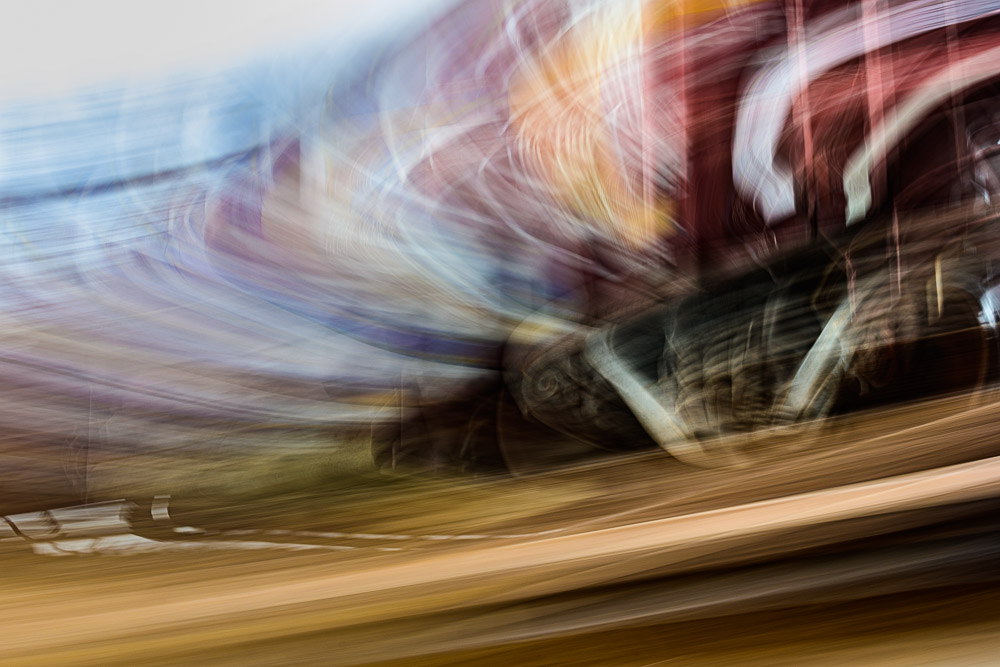
    Earlier I mentioned ICM as a tactic I have been using occasionally to break away from the feeling I needed technical perfection. This image is an example of that. It is from a series I did called Speeding Trains. The intent is to capture the sight and feeling and power of a huge train speeding by. I hope you like it. Read the artist statement and see the rest on my web site.

  • When Do You Make a Picture?

    When Do You Make a Picture?

    When do you make a picture? Have you thought about that? On the surface, it seems an ambiguous or simplistic question. I have been asking myself this, though.

    Time, place?

    I could be flippant and say I make pictures Tuesdays in the canyons west of my home. That is not true, though. I capture images at least 5 days a week, in general. And I make pictures most places I go. There is no special place for making images.

    Looking for things to satisfy my curiosity is not about a time or place. Even traveling to an “exceptional” destination is a special case of just making images wherever I am, of whatever interests me, whenever I have a chance.

    The click

    OK, so you could say I make a picture whenever I click the shutter of the camera. While it is true that the shutter release is the event that causes the recording of the data in front of the lens, I have written before about sometimes needing to think about and process the data before I am done.

    When I go out shooting and come back with 200 images on my memory card, does that mean I have made 200 “pictures”? No, but it is a subtle semantic distinction. My answer would be that I have 200 new possible pictures at this point. However, I am going to go through them, cull out the defective ones, decide which of the duplicates I want to keep, and then try to decide if there is any merit in the ones that are left.

    When all is done, maybe I would end up with 0-10 that are worth doing something with. Your mileage may vary. Mine does, too, depending on time and place and my mood. Note that I still have to do things with them. In my mind, they are not “pictures” yet, since I am not ready to show them to anyone.

    Post processing

    So, of course I have to post process the ones I have kept so far. This may only involve simple exposure processing, especially corralling highlights and shadows, color correction, and contrast adjustment. Typically there may be some spotting and minor blemish removal.

    At this point I “may” have a picture. For straightforward scenes, this may be enough. I am done. It may be beautiful or interesting and no more than the literal scene before the camera. A lot of pictures are just that.

    Deciding what it is and it is going to be

    But not always. Sometimes an image is trying to tell me that it is something more. It may take a while for me to hear it. This often manifests as a discomfort I can’t quite identify. A suspicion that I am missing something.

    When this happens during the initial culling process, I usually keep the frames I am struggling with. I might not be able to articulate why, but I know I’m not ready to eliminate them yet.

    Even after the image is processed and is a nice picture on its own, sometimes it keeps trying to talk to me. Deep down inside, I know I have not understood or brought out all it means to me.

    Sometimes I realize I have been capturing images of a certain subject or mood. I may recognize a theme that is emerging. Recognizing it helps me identify and clarify a truth I was not consciously aware of. This could put me on track to follow the idea for a while as a project. With these nagging images in context, I learn more about why they were talking to me. All seems different. Sometimes I don’t even need to modify the images more. Just understanding what I was feeling may be enough.

    Combining

    And sometimes I recognize an image is an interesting piece, but not complete in itself. I will often file these away as raw material, expecting to revisit it is the future and decide what it needs to say what it wants to say.

    There are times when it comes to me and I know that these pieces have to fit together in a certain way to create a new image. This can be satisfying, fulfilling, exciting. It is a true creative journey.

    It is time consuming but often very rewarding to spend sessions in Photoshop playing with various combinations of pieces and parts, doing “what if?” games. These often end up in “failure”. Failure in the sense that I did not create a new picture. But it is seldom actually failure because I explored ideas and tested new things. It often sparks new ideas for the future.

    Disconnected from capture

    This comes around to an idea I have presented before. Sometimes I have to let an image age before it becomes whole. It can take me an indeterminate time to recognize what the image wants or needs to be.

    Images are raw material until I become comfortable with how they should be expressed and presented. This is a separate creative process from image capture and a necessary part of how I make a picture. It is not until the end of this journey that I feel I have a picture to share with the world.

    Today’s image

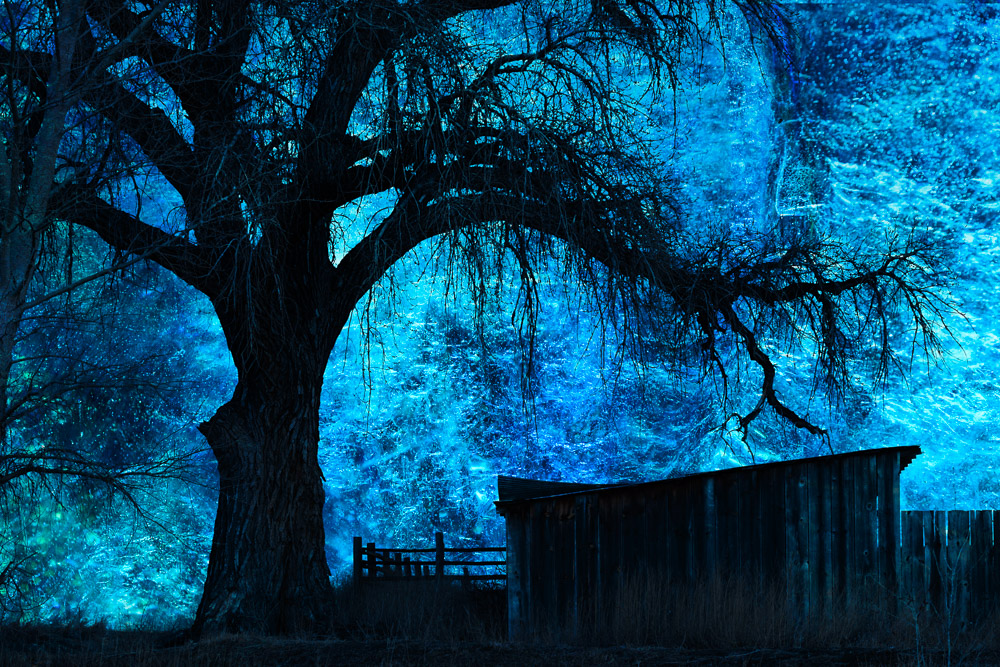
    The image with this article is a minor example of what I describe. I was fortunate to find this scene late one winter afternoon in what I considered an unlikely place in the back country of northern Oklahoma. I’m a sucker for lone bare trees silhouetted against the sky.

    I liked it, but I know it was not “done”. A few months later I added the birds, because I felt they built and reinforced the mood of the image and added some dynamic interest. Just today when I came back to it again after about another 6 months, I saw I wanted to eliminate some distracting foreground elements, crop it to emphasize the sky, and make it overall higher contrast and more saturated. I’m good with it – for now. 🙂

  • Going too far

    Going too far

    We often hear this as a challenge or criticism. “You’re going too far” Meaning, back off. But as an artist, I don’t think I go far enough. I need to push myself to be always going too far. That is how we explore the limits

    Too timid

    I have written about this before, but it is so important I think it deserves a refresh. In a previous article I encouraged us to go “far enough“. But I think now this is too timid an attitude. We should push “it”, whatever it is, too far.

    I know I tend to have too much focus on the actual captured data of the file and what the scene really looked like. Time helps. I tend now to wait to process images until they have aged enough to let me distance myself from the experience of being there.

    But still, I tend to hold back and stay too true to the original. I am learning to push beyond to create something else.

    As a bonus, this short video by Matt Kloskowski might encourage you to think about editing in new ways. He does not talk much about going too far, but he shows an unconventional approach. The kind of thing I am talking about when I recommend pushing beyond the captured data.

    Push it

    I know I’ve said it before, but I find truth in something John Paul Caponigro said “You don’t know you’ve gone far enough until you’ve gone too far.”

    This is something I need to take to heart. The engineer in me tends to make the image look like the literal, original scene. That ends up creating record shots. Sometimes all I need is a record shot, but that is rare. I have to push it more to make the image into art. Into something interesting that goes beyond the original.

    For example, I live in Colorado. If I shoot a beautiful scene in the mountains, so what? Anyone could have stopped there that day and taken the same picture with their cell phone. What sets mine apart? It often will be something more than just the literal scene. It has to rely on my interpretation of what I saw.

    Be decisively indecisive

    So when I suggest going too far, I am not speaking about relationships or physical safety, but my interpretation of the image. I am discovering more and more with time that images can take a great deal of manipulation.

    A raw file from a good camera contains a tremendous amount of data that can be exploited. Editing in Lightroom is completely non-destructive. We can re-edit at will with absolutely no loss. Likewise, although Photoshop is inherently destructive, there are processing techniques that can be used to manipulate images with no damage and with the ability to re-edit in the future. I strongly advise learning and adopting these techniques.

    Yes, I know of good artists who can say they know exactly what they want to do with an image and it is OK to do destructive edits, because they will never change their mind in the future. That is not me. Every time I revisit an image I usually tweak it some. Sometimes a lot.

    Does that mean I am indecisive? Perhaps. I wouldn’t argue the point. I look at it as an evolving artistic judgment. What I see and feel in an image can change over time. So I consciously decide to use techniques to give me the maximum flexibility to change my mind later. Decisively indecisive.

    Don’t worry about breaking it

    Let me use Lightroom (“Classic”, because I consider it the only real Lightroom) as an example. I said that all editing in Lightroom is non-destructive. Do you really understand that?

    Lightroom uses a marvelous design that always preserves the original data unchanged and keeps all edits as a separate set of processing instructions. Don’t believe me? Here is a portion of actual data from the XMP sidecar file of an image I edited today:

    crs:WhiteBalance=”As Shot”
    crs:Temperature=”5650″
    crs:Tint=”-14″
    crs:Exposure2012=”+0.50″
    crs:Contrast2012=”+6″
    crs:Highlights2012=”+19″
    crs:Shadows2012=”0″
    crs:Whites2012=”0″
    crs:Blacks2012=”-12″
    crs:Texture=”0″
    crs:Clarity2012=”+20″
    crs:Dehaze=”0″
    crs:Vibrance=”+5″
    crs:Saturation=”0″

    If you are familiar with Lightroom, you should recognize these adjustments as the contents of the Basic adjustment panel. I’m not sure what the “2012” suffix means on them, but probably a process version. Anyway, this is literal data copied from the XMP file. It is an industry standard format called XML markup. It is just text. If I change a slider, the text value is changed. These text values are read and re-applied when I open the file in Lightroom. The original pixel data is never altered. You cannot destroy the image by editing it in Lightroom.

    What are the limits?

    There are limits, but not absolutes. If we boost the exposure too much, at some point we will introduce an unacceptable amount of noise. If we sharpen too much we will introduce artifacts around edges. We can make such a high contrast image that it cannot reproduce properly on screen or in print. We can increase saturation to the point that it is out of gamut for the screen or print.

    Most of these are sort of a judgment call by the artist of what the acceptable limit is for the intended application.

    But these are just physical limits of what we can do with the tools. The bigger problem, at least for me, is what am I willing to do?

    It’s our mindset we need to break

    I am the one who usually limits the extents of the changes I will make. I am still too much of a left-brained engineer who is constrained by my memory of what the scene actually looked like.

    One way I can tell this is happening is that it is common for me to push an image further every time I revisit it. Upon seeing it again, I think,”that is nice, but I can go further”. And I do. Sometimes the image turns into something different from what I shot. I love it when that happens.

    But it is a constant struggle to give myself permission to do it. I am afraid of going too far.

    Knowing how the tools work and how to non-destructively edit, I should feel free to slam adjustments to the limits just to see what happens. Then back off to the “right” value for the image. I find that the “right” value tends to be higher if I have over-corrected than it is if I come up from the original. I think this is what Mr. Caponigro means when he says “You don’t know you’ve gone far enough until you’ve gone too far.”

    Give yourself the freedom to go too far, than back off as necessary. I will try to do the same.

    Not for everyone

    I know this advice is not for everyone. I still see photographers who say they pride themselves in getting the image “right” in camera and doing minimal editing. That’s their style and their values, so good for them. But if “right” means the closest match possible to the real scene, that seems very limiting. I think we have progressed well beyond the stage of assuming that a photography must be a true representation of reality.

    At least, that is my assumption. I operate from the point of view that I am as free to creatively imagine the contents of my frame as a painter is to create on a blank canvas. Even plein air painters take a lot of liberties with what they choose to include or exclude, what colors to use, etc. Some even use the plein air session as a sketch. Later in the studio they refine and complete it according to their interpretation.

    That is basically what I do. Some images require more interpretation than others, and my tools allow more freedom for manipulation. One reason I think I could never paint is there is no “undo” with paint. 🙂

    Go too far

    So I am discovering that what works for me is to consciously push my adjustments beyond what I first think is right. Yes, it may create a bizarre effect and I have to back it off. But I often find that the new setting I back it off to is more extreme than I thought was correct originally. Seeing the extreme helped me understand a new way to view the image.

    If you do it right, you can’t damage the image. Give yourself permission to experiment.

    Example

    The image with this article is an example. This is the mountains and plains about 5 miles from my home. It seems like every time I go back to the image, I need to tweak it a little. And I always push it a little further. I do not back off of what I already did. I think I am nearly to “far enough”.

  • Learning to See

    Learning to See

    Learning to see is something we all need to constantly practice. Seeing is actually a learned process. Yes, we can image scenes on our retina, but that is not what I mean. With practice we can learn to see more of what is around us, to be more aware and mindful.

    We learn to not see

    Children seem filled with a sense of wonder at everything around them. It all seems exciting and amazing. But somewhere along the path to becoming an adult, this excitement is squeezed out of us.

    In school our peers pressure us to look down on everything with disdain. Being excited about things is “not cool”. In our work life we have to learn to develop a single-minded focus on the tasks of the job. Non-essentials get pushed away. We may get married and have a family. This is great, but it focuses us even more on the day-to-day activities we have to do to earn a living and keep the household going.

    Eventually we no longer really see anything except the immediate problem that seems important. To some extent, we have to do this. It is a survival technique. But it takes away so much potential joy and beauty from our life.

    It takes an effort to start to see

    Are you at a point in your life now where you realize there is more going on around you that you are not perceiving? You look at other people’s art and become aware that it is not just about great iconic locations. They seem able to find beauty and interest in all kinds of places. They are attuned to their surroundings and open to more.

    Practice seeing. No, really. That sounds silly, but maybe it is time to re-learn how to see. That vision that came so easily and naturally when we were a child can be regained to a great extent.

    You know that it takes practice to develop any skill. Why does it seem strange to practice seeing? Isn’t seeing a critical first step in making art?

    Does it seem unlikely that seeing is something that can be learned? We just do it. I believe it is a skill that can be improved. The fact that we used to do it easily but forget how over time means we have the inherent ability to see better. Sharpening that skill can make a huge improvement in our art.

    Overcome lazy habits

    As I mentioned before, we tend to narrow our circle of interest as we “grow up”. Part of this is a coping skill, but some of it is just laziness. We’ve seen it all. We’re bored with it. It is all the same, so why pay attention?

    You would be surprised at the interest all around if you were just looking. Seeing more is rewarding in itself. It brings more interest to our life.

    Like developing most new habits, a key first step is awareness. When you are out walking or driving or riding your bike, make a habit of reminding yourself to look around. Changing any habit takes time and you will need to remind yourself over and over to do it.

    Pay more attention to where you are and what is going on. Even if you do not improve your art, improving your situational awareness will keep you safer.

    Try to become more curious about what is around. Where does that road go? Those tree branches make an interesting shape. I’ve never noticed that this little stream is quite lovely at certain times. Look at the great reflections in that glass.

    Curiosity is the magnet that helps pull us to look more. It is also a trait that can be developed. If you re-awaken your curiosity you will find it almost impossible to keep from seeing more interesting things around you.

    Becoming mindful

    I almost hesitate to say we need to become more mindful. The concept is great and true and is a good description of what we need to be able to see more. The problem is that too many people go overboard with it. It gets all wrapped up in transcendental meditation and eastern religious practices. You do not have to be a yogi to be mindful.

    As the link above states, “Mindfulness is the basic human ability to be fully present, aware of where we are and what we’re doing”. That is harder than it sounds. Consequently, many say “we don’t want to spend time to learn what this means. Give us a quick hack that will let us do it in 10 minutes”. So it becomes a program someone is selling. Or a mystical incantation. Or something you wedge into a daily meditation regime.

    Instead of all that, just pick out a certain time and place and practice for a little while clearing your head of the normal clutter that vies for our attention. When you go out for a walk, whether or not you bring your camera, forget about the project that is due tomorrow or tonight’s game, or what you will fix for dinner – and especially Facebook or your personal social media addiction. Instead, try to be fully aware of just the moment. Where you are, what you feel, what sensations you are experiencing. Look around with curiosity. Try to see things you have never seen before.

    It may be hard or even frustrating at first. Push on. It gets easier.

    The more you see

    When you really get in to it, you will find this exercise relaxing. Getting out of the normal grind for a few minutes is refreshing. It is a vacation for your head. And you start to see more things. Interesting things you never noticed before. Even right there in your neighborhood. You will probably find the experience to be invigorating and something you want more of.

    As a matter of fact, it is a feedback process. The more you begin to see, the more you see, the more you like to see, the more you want to see. Each outing, it becomes easier to see new things. You find it easier to focus you attention on the external things in your environment. Things that you used to pass by with no recognition start to become very interesting in themselves. It is a mental game that sparks new interest and awareness. You come back from an outing refreshed instead of tired.

    Practice

    Start slow. You will “fail” a lot at first. That’s OK. As long as you keep trying, you will get there. Just commit to doing it.

    Don’t think you have to go out for 3 hours with a totally clear head, completely open to new sights and sounds. Maybe someday, but don’t frustrate yourself with setting a goal like that initially. Start with 10 minutes. Just walk around and note a couple of things you haven’t seen or haven’t paid much attention to. Then celebrate by rewarding your self with a coffee – or your preferred beverage or treat.

    It is a cause for celebrating. It is a step toward re-awakening your awareness of the world around you. Dare I say, you are becoming “mindful”?

    Today’s image

    The image with this article is an example of what I suggest for your exercise. I was stuck in the Orlando airport. Everything was shutdown temporarily by a thunderstorm. I got bored reading and walked around to stretch a little.

    Then I noticed the trains coming in from the terminal. This one was mostly empty because no flights were going. It was beautiful. I shot several images and this one captured the spirit of the occasion.It brings me joy. I am glad I noticed it.