An artists journey

Blog

  • Behind a Mask

    Behind a Mask

    It seems like we are all looking at the world from behind masks now as the Covid-19 virus keeps most people locked in. There are other masks, too. It can be a metaphor for several things.

    I’m going to talk about fear and isolation. But I want to be clear, if you or someone you are around is in a vulnerable health situation, then you absolutely should take precautions. I’m going to address the wider population.

    Photoshop masks

    I have used layers and masks in Photoshop for longer than I can remember. Masks are a great invention here. They allow very selective and detailed editing or modification of anything in an image.

    Photoshop masks are one of significant features that allows Photoshop to be the most powerful and respected image editing software available. I will go out on a limb and say that virtually all serious Photoshop users use masks.

    But there is something special about Photoshop masks in regard to the metaphor of masks as I am talking about them today. Photoshop masks are completely a private, hidden thing. I use the masks as much as I choose to, but it is not visible or obvious to anyone looking at my image. It is a private thing between me and my image. No one knows if I used a mask and no one tells me I need to use one. No one cares, unless I’m “talking shop” with a colleague. Photoshop masks are not something we wear in public.

    Face mask

    Now days, though, most of us have to confront wearing physical face masks when we are in public. Fear of this horrible virus has made the world go crazy. Fights have broken out, even shootings over whether people are or are not wearing them. In some places you could be fined or even arrested for not wearing one. Even if not, you may be shunned or abused for not wearing one.

    What is this doing to us as a society? What is it doing to the kids? What precedents are being set for the next supposed crisis?

    How did a simple piece of cloth wrapped over our face come to mean so much to so many people?

    Fear

    Fear drives this panic. The media pumps it and thrives on it. Anything that causes widespread fear uncertainty and doubt generates ratings and revenue for the media. For weeks, every single story on my local media was about the virus. Follow the money. Only recently will something like a gory killing get a spot in the news.

    But the media is giving most people what they want. People have decided that this panic is important enough to control their lives. It is too dangerous to go outside or be with people. Something bad may happen. Better to huddle inside. Don’t go to work. Don’t go to school. Don’t go shopping. Don’t support you local businesses.

    It might not be safe.

    Death isn’t the enemy, fear is.
    Ellen Gilchrist

    Success tends to go not to the person who is error-free, because he also in risk-averse. Rather it goes to the person who recognizes that life is pretty much a percentage business.
    Donald Rumsfeld

    Speaking of the percentages, let me put some of this fear in context. As an Engineer in a past life, I look at data. Based on numbers published in the Washington Post on May 18 2020, the probability of you dying of the Covid virus in the US is roughly 0.0003 right now (90,991 death out of roughly 300,000,000 people).

    You are much more likely to die of heart disease or cancer. You are at greater risk when you get in your car and drive somewhere. And over 60,000 people die in the US each year from the flu – that is every year. All depressing to think about, but there is always a non-zero probability of you dying at any time. You could be struck by lightning or hit by a meteorite.

    But we shut down the whole world because we are afraid of this particular problem.

    Hiding

    So we hide. Being alone or just with your immediate family, who you can’t get away from, must be safe. Safety is everything.

    Going to school is not safe. Going to work is not safe. Visiting with your neighbor is not safe. Eating in restaurants is not safe. Going out walking is not safe. If you get a package you ordered from Amazon, let it set a couple of days before opening it, just in case. To be safe.

    Put up the shields, our face masks, when in doubt.

    Where did our faith in these little patches of cloth come from? A mask won’t do much to protect you from the virus unless it is made from appropriate materials and is thick enough. Very few of our homemade masks are effective. A mask won’t do much good unless it fits properly. Few do. And if you have facial hair, like I do, they are generally useless.

    For the most part, these have been sold to us by the authorities as a talisman to help us believe we are doing something to stay safe. Like most juju, they are mostly for making us feel good.

    Our masks are something to hide behind. To hold up to the world as an amulet to ward off evil spirits. Not necessarily a placebo, but close.

    But at what cost?

    Isolation

    Huddling at home, not going out except for emergencies, shunning all people – these things have a cost that may be greater than the cost of getting the virus.

    Despite all our wonderful technology, society and human beings work on personal interaction. It is critically important to interact with people. A smile or a touch means much more than a long email. Seeing a friend and shaking hands is vastly better than any text message. No matter how many emojis you use.

    A mask is a barrier. It is a wall. It says I am afraid of you so I am distancing myself. It says I assume you are dangerous so I am keeping away. It says that my perceived safety is more important than whatever interaction we might have had. It says I am retreating within my shell where I don’t have to be with you. Because I am afraid.

    And on a more personal level, it says I am willing to live my life under cover, huddled indoors, in fear because the world around me may not be safe.

    If today were the last day of my life, would I want to do what I’m about to do today?
    Steve Jobs

    I’m not willing to hide from life and people. I want to use all I can of today.

    Normal

    Where we are is not a “new normal”. It is a temporary panic. A world ruled by irrational fear. I hope that a long term effect of this is to make people re-evaluate their priorities. Decide what is really important.

    Jobs are important, but it should not be the center of your life. Entertainment is fun, but only as an occasional distraction.

    What are the things you have really missed during this lockdown? Is it family, friends, socializing with people? Even visiting with the people at work? Hugging or shaking hands with friends? Going to church with your people and singing and praying together? Sitting around people at a restaurant, being awash in the social interaction? Getting together with a group of friends and just talking?

    We have been denied this things. We have been told that perceived safety is more important than people. I believe our leaders have been wrong. Their fear for the safety of a few has caused massive distress for the many. We need to help our world get back to a better place.

    We need to stop hiding behind a mask and get back together with people. We need to evaluate what our priorities are and work to make sure they happen. Living in fear is unhealthy.

    Post-Script

    Many of you may not agree with me. That is OK. I hope to generate thought, not necessarily praise. Since I set out to be more self-disclosing in this blog I thought it important to say something about the largest event going on in the world around us right now. I promise, though, that writing about current events will not be a regular thing.

    I value your comments and inputs. Let me know how it is going for you and what you think!

  • Ordinary/Extraordinary

    Ordinary/Extraordinary

    I think most of us try to avoid the ordinary and instead seek the extraordinary when we look for subjects to shoot. It’s almost like we equate ordinary = bad; extraordinary = good. This may be a limiting approach. Changing our attitude may open important new creative experiences for us.

    This is something I have believed for a long time. The travel restrictions from the Corona virus have made me re-examine this issue. I came back around to the attitude that the ordinary is potentially our richest source of inspiration.

    Extraordinary can be great

    Don’t get me wrong. When you encounter an extraordinary experience, live it, soak it up, revel in it. Those things happen rarely for most of us. Maybe it happens for you on a special trip to a “bucket list” location. Maybe it is an event you have planned for a long time.

    Whatever it is, be there, be in the moment, enjoy it. You might even make some great images.

    But don’t think an experience like that is a requirement for you to make great images.

    Not all scenes need to be grand

    Do you really need a grand scene to inspire you to your best work? Why? Are normal scenes not worthy of your effort? Is a scene in New Guinea inherently more worthy than one down the street from where you live?

    There is a strong argument that the ordinary, everyday scenes you are familiar with are some of our best opportunities. Familiarity might breed contempt, as the old saying goes, but actually, familiarity more often leads to intimacy. Getting to know a subject, knowing its moods and looks, finding its real character can lead to images that have a special depth. Even love.

    Some would even say that a steady diet of grand scenes is kind of like eating junk food. It might taste good at first, but it doesn’t have the substance you really need for a balanced life.

    Beauty in the ordinary

    The ordinary can be beautiful in ways that extraordinary scenes can’t compete with.

    Almost all of life is lived in the ordinary. I wanted to honor what we see every day, our shared experiences. Rain. Street workmen. Coke bottles. The more I looked, the more I realized there are wonderful shapes and colors and beauty to be found everywhere.
    Dianne Massey Dunbar, in Fine Art Today magazine

    As Dianne says, there is wonder and beauty to be found everywhere. Monet did most of his work in a narrow slice of western France along the Seine River. Van Gogh did most of his best work in Provence. Ansel Adams worked mostly in California. Georgia O’Keeffe is strongly associated with New Mexico. Even though all of them occasionally lived or traveled other places and did great work, the point is that they thrived best “at home”. The “ordinary” everyday scenes they loved inspired them to greatness.

    Their love of the place they lived gave them a special relationship to it. They were excellent enough artists to express that relationship in their work and help their viewers to see the world through their eyes.

    Find what inspires you

    We are each drawn to the world around us in different ways and for different reasons. Some are drawn to faces, others to grand landscapes, still others to intimate landscapes, while some relate mostly to wildlife. Others may reject looking for particular subjects and view the world as objects for abstract expression or black and white.

    The point is that we usually become drawn to certain things or types of images. More often than not, these are things we know well and see often. Things that are ordinary for us because we live with them. Things that other artists may walk right by without noticing, because they are not inspired by it.

    But when something inspires us it can produce magic. Like Monet with a Lilly pond. Or like Van Gogh with crows in a wheat field or with a night sky.

    When we are drawn to something, it becomes extraordinary. The magic happens because or our relationship to the subject or scene. It is the artist’s subjective expression of that relationship that transforms it to art.

    I encourage you to learn to be more open to the ordinary around you. Learn to really look at those common things you normally pass by. It can be the greatest source of inspiration you will find.

    Intimacy

    I believe a lot of it comes down to intimacy with your subject. A grand, once-in-a-lifetime scene may be fun, but it is a “one off” experience. It probably is exciting at the time, but there is no real intimacy or depth.

    I have been married a very long time, and I can say with assurance that long term relationships are far more rewarding. It is similar with your subjects.

    When an artist creates an image, he is revealing his subjective relationship with the subject. This is one thing that makes one of Monet’s lily pad pictures much better than anything I could do with a lily pad. He developed a special love for them over time. I do not have any strong feeling for them.

    Intimacy is defined as familiarity, friendship, closeness. I believe that when we develop such feelings for our subjects, it comes through as deeper and more meaningful images. We are most likely to develop these feelings with the ordinary world around us than by waiting for a once-on-a-lifetime experience. Familiarity really does lead to intimacy.

    Stop. Look. See. Really see. Look again. Think. Visit with these things. Learn about them.

  • Open to the Unexpected

    Open to the Unexpected

    When you go out to shoot do you know before you leave exactly what you want to find? Many people do. I feel sorry for them. I greatly prefer to “go out empty” as Jay Maisel would say and let the amazing world around me surprise and delight me. Learn to expect the unexpected.

    This is absolutely my opinion and my photographic style. I am a fine art photographer who works primarily outdoors. The world outside is my canvas. If I were a portrait or commercial photographer I would have to do things differently. When there are crews and talent and art directors and contracts to fulfill, I recognize that the photographer has to plan and organize tightly. I am glad that that is not my world. I thrive on spontaneity.

    Subjective vs. Objective

    In a recent webcast by Chris Murray on Nature Photographer’s Network, he discussed the idea of objective vs. subjective photography. (Sorry but this is a fee site, but you can sign up for a free month.) It was a good talk. He spend a lot of time on his journey from objective to subjective.

    He characterized objective images as ones that document a scene and subjective images as images that convey how the artist felt about or responded to the scene.

    I think most of us start out objective. It happened naturally when we point our camera at a beautiful landmark and get a picture that makes us say “wow, that’s beautiful”. But if it has no more interpretation by us, it is not really different from the hundreds or thousands of other captures of that scene.

    The thing I want to point out here, though, is that Chris said when shooting objective images he would research a location, decide the time of year and time of day that would be best for it, and go there and sit until the conditions were what he expected. He told about camping on a mountain for 3 days waiting for the image he visualized.

    The image he got was a beautiful scene in the Adirondack Mountains. But my reaction to it was “meh…”. (Sorry Chris). To me it did not have any passion or depth. He got almost exactly the shot he planned, but my thought was “why?”.

    What do you miss?

    What did he miss while he was waiting 3 days on that mountain for the “right” time and conditions? Maybe nothing, but maybe a lot. To me that is too great a price to pay.

    I have heard other photographers talk about fighting for a tripod spot at a grand, iconic spot, realizing that they were about to take the same shot that thousands of others take every year. Then they turn around and see a scene the other direction that is more meaningful to them. One that most of the other photographers failed to see because they were totally fixated on the iconic scene.

    I try to be open and aware of what is around wherever I am. Same applies as much if I am walking a downtown street as if I am in a wilderness. Wonderful images can be discovered anywhere.

    Avoid preconceptions

    If you decide before you head out what you want to shoot, you put mental blinders on yourself. It is a fact that you only see what you expect to see.

    This is called “selective attention”. A famous, effective, and short demonstration of this is in this video. Watch it! It is very enlightening. I won’t give a spoiler here, but this applies to any of us. If you are only looking for birds you will tend to only see birds.

    Maybe that works OK for you. It’s not what I want for me. I want to be open to all the exciting things around me. And there are a lot of them. Many of my favorite images are things I would not have known to look for if I was making a list beforehand. I don’t want to miss out on the excitement of truly seeing and openly exploring what an area has to offer..

    Grow

    We all need to practice our skills and our visualization. Even the most famous and experienced photographers make themselves take time for personal projects to keep from getting stale and to grow in creative ways. Learning to avoid the trap of preconception can be part of that growth.

    All artists need constant practice. Pablo Casals was possibly the greatest cellist.

    The world’s foremost cellist, Pablo Casals, is 83. He was asked one day why he continued to practice four and five hours a day. Casals answered, “Because I think I am making progress.”
    — Leonard Lyons

    Repetition is one thing. I have advocated for that before. It is necessary. But there are other ways of learning to break your habit of preconception.

    A great thing to do is to go minimalist. Go out for a day of shooting with one camera body and one lens. I can hear you sputtering now. ☺ “But I might need my fisheye; or I might need 400mm”. No, not if you don’t have it. Practice getting great shots with what you have.

    An interesting thing happens when you let go and go with it. Let’s say you just take your 50mm prime. When you get into it, you will quickly start to see the world from the 50mm perspective. This is probably a type of selective attention, but it is forcing you in a different dimension. Instead of being selective on subjects, you are selecting your viewpoint on the world around you. It is a great exercise.

    I did something similar on a larger scale. My natural vision is telephoto. My ideal lens is 70-200mm. Even longer is great for me sometimes. I like to crop in on details. But for over a year I have switched to mainly shooting with my wonderful 24-70mm. I think it has helped me grow in my creativity. I am surprised at some of the new things I see.

    Let yourself be surprised!

    For me, my art is a voyage of discovery. It is exciting because I never know what I will find. I like to be surprised!

    When I can get into seeing the excitement and possibilities all around me there is sometimes so much to shoot that I have to just stop and take some deep breaths. Slow down. Decide how I feel about what I am seeing and what I want to say. Pace myself. It can be an embarrassment of riches. I am drowning in the imagery.

    The image with this article is an example. I was head down by a lake shooting grass and reflections. That is all I was paying attention to. Eventually I noticed that things were changing and getting colorful. Looking up, I discovered this gorgeous thunderstorm was forming practically right by me. This became the picture. The other images I shot that day are forgotten.

    It even applies to post processing. Sometimes I shoot frames just because my instinct tells me there is something there I am not consciously seeing. Sometimes whatever I was drawn to becomes apparent in post. As I work an image, something magical begins to emerge. It is like creating an image in front of me on the screen directly from light and the manipulations I am doing to coax out an elusive something. That is a joy, too. It is the kind of surprise that makes art worthwhile.

    So I invite you to stop limiting yourself artificially. Don’t block your vision by deciding in advance what you only want to find. Let go. React. Be open to the unexpected. Go out empty, as Jay Maisel famously says. Enjoy discovering what there is instead of being frustrated by what you can’t find.

  • Ansel Wasn’t an Oracle

    Ansel Wasn’t an Oracle

    Ansel Adams famously said that the negative is the score and the print the performance. Ansel was one of the great lights of 20th Century photography and his writings are generally very good. In this case, though, I think this famous quote has become a little outdated by technology changes.

    I love this quote and have been guided by it for a long time. As I began to understand it more deeply, it was empowering. For a long time my work was basically a documentary or reportage style. It was very literal photography of scenes in the natural world. I even for a time subscribed to the false doctrine that if an image was altered in any way it was no longer pure and virtuous.

    Ansel’s quote helped me understand that that had never been true and was not a worthy or even useful goal. At least for me. I truly believe that the negative (raw file now) is only a start. It usually must be perfected by the artist to become art rather than just a record of something.

    The darkroom process

    Let me talk a little about the darkroom process, as I understand it. This is so I can contrast it to the current workflow. I will confess that, although I built a darkroom in my basement, I only ever used it for a few black and white images. About that time I discovered a new program called “Photoshop”. 🙂

    The image captured on film is generally considered “read only”. It is never modified. There are exceptions to every rule, but this is by far the typical case.

    The extensive set of transformations and modifications that can be applied to the negative in the course of printing are done in “real time”. That is, it is a dance involving adding or holding back light from certain areas during the time the paper is exposed to light. It can also involve variations of development time or chemicals and even manual operations like bleaching or spotting of the print.

    Given this workflow, it is completely appropriate for Ansel to describe it as a score that will be performed by an artist. The outcome will vary somewhat with each performance, depending on the feelings and inspiration of the performer. Each print is a unique creative process.

    The digital workflow

    Fast forward now to the current generation of digital imaging. Digital imaging is wonderful in too many ways to list. I absolutely believe it is superior to film in almost all important respects. There is no reason for most artists to ever want to go back to film and chemicals. Your mileage may vary, but that is a personal artistic decision.

    One of the places where digital processing is most different is in the post processing to complete the image. The raw file (the “negative”) is processed in the computer using software like Photoshop.

    The software allows extensive, non-destructive manipulation of the image. The great dynamic range captured by modern sensors now gives us far more information to work with and more freedom to transform the image. It is easy to remove distracting elements, composite images together, and vastly change the tone and color profiles and even exposure.

    Ansel had to select a type of film to use prior to taking an image. He also had to use color filters to change the tonality of his black and white images. It was a guessing game based on lots of experience. He called it “pre-visualization”. Now we retain all the color information until processing time and we can convert to black and white via multiple types of software transforms and with extensive control over tonality. Much more subtle artistic decisions can be made. He would have loved it.

    Furthermore, these changes are built on the computer and recorded as a complete package. All the modifications can be done slowly and I can backtrack, undo things I don’t like, try alternatives, even easily create multiple versions of an image.

    The “performance” aspect of Ansel’s darkroom manipulation now becomes a considered, one-time transformation. All the artistic decisions are immediately seen on my nice color corrected monitor. I can study the effects at leisure and decide to change them. When I am done, I have virtually a finished image.

    The print

    It almost sounds like printing has been reduced to a minor step. Not so. It is still a complex artistic process. But again, the digital world gives many new options.

    Choice of paper is a big deal. It controls a major part of the look of the resulting image. A glossy Baryta has a very different look from a matte watercolor paper. Paper with varying textures and base color can be selected.

    This is assuming you are printing yourself. I recommend it. It is a joy and it connects you with the final product. But many other options are available. You can have your image rendered on canvas, metal substrates, acrylic, transparencies, cloth – too many to list. All vary the look and potential use of the final image.

    But the thing that is ultimately the most different from film days is that the artistic result has been determined prior to hitting Print or sending the file to the producer. Each time you print the image, the results should be so repeatable as to be indistinguishable. As Alain Briot said, somewhat tongue-in-cheek I think, this is one of the problems with printers: they do not need our help in any way while they do what they do.

    So, in a way, a print is like a good illusion. The magic happens before we ever see the print appear. This is a huge contrast to the film days where creating a print required a virtuoso performance in the darkroom.

    Was Ansel right?

    I believe Ansel was completely right and very insightful when he wrote this famous quote. Like with many things, though, time and technology changes. Since he was describing a particular technological process, it is not surprising that it will change.

    The real genius of the quote, and the reason I believe it is still useful, is to point out that the captured image is only the starting place. I am free to apply my vision to complete the image. Without that injection of originality, it is too easy for it to just be a snapshot.

    How that is done is not that big of a deal. Art is a physical product and expressed via currently available technology. The technology should not determine an artist’s vision. Make it your own.

    The quote was an observation by a great and experienced artist. It did not come down from heaven written on stone. Don’t be limited by changes of process or technology. Understand that it frees you to create!

  • 15 Minutes From Home

    15 Minutes From Home

    It is pretty easy to take good images in exotic locations. A real test of our skill is to see how well we do in familiar territory close to home. What if we arbitrarily said we were going to restrict ourselves to 15 minutes from home? Actually, that kind of sounds like the situation many of us are in right now.

    I use ideas from Cole Thompson too often, but he often says things I wish I had said. In a recent newsletter of 3/27/2020 he challenged the idea that you have to go to great locations to take great pictures. Referring to the fact that many of his recent images were made in far flung locations, he said “You see the same coming from other photographers: exotic images coming from exotic lands. The conclusion is obvious: To create great images you must go to great locations! But that’s a lie. The real truth is this: great images are created anywhere you can see them. Even at home, your back yard or hometown. “

    He went on to show a portfolio of great images taken within 15 minutes of his home. To me, his picture of wrenches hanging in a tool shed is at least as beautiful and intriguing at the classic figures on Easter Island.

    Then why travel?

    I will readily confess to being a traveler. I love to travel (hate airports and airlines though). Seeing different cultures and different landscapes energizes me. I tend to see things with a fresh eye. It’s an opportunity to give yourself permission to be a tourist and to view new things differently.

    Travel makes you set aside time for the new. It removes you from the clutter and noise of your everyday environment. It may replace it with different clutter and noise, but the difference makes it new. Plus, you don’t worry much about the routine things that occupy you at home. That email you need to write, the business contact you need to follow up on, that blog post you have been meaning to write – they are just a distant murmur in the back of your mind. The lure of the exotic location tends to drown out the mundane things that usually shout so loud for your immediate attention.

    The immediacy of the new sights in front of us makes it pretty easy to lose ourselves in the experience.

    Burnout

    Many of us can get in a rut and suffer from creative burnout. We start to think there is nothing new to photograph. Nothing new to inspire us or make it worth even getting the camera out of the bag. Travel to a new location seems to hold the hope of drawing us out of our slump.

    I’ve been there. I still fight it frequently. Now with travel restrictions it seems worse than ever. What can we do?

    I advise you not to get overly frustrated and fight head on against it. Reframe the problem. Go out walking with your camera. Tell yourself you do not expect to make any portfolio images today. You just want to look and practice, maybe work on technique. With no pressure to try to “make” a great shot you might be surprised at what you see. Give it time to work.

    You will probably find yourself less dismissive of things. You might notice new things you never took the time to actually see because you were too focused on a preconceived notion of what you wanted to find.

    Burnout is a real problem, physically, mentally, and creatively. Let yourself heal by taking it easy. Ease up on yourself by reducing the pressure you feel to make “great” shots every time.

    And do something. Don’t let yourself wallow in feeling sorry for yourself. Get off your rear end and do something. Anything. Build something. Take walks or bike rides. Keep moving.

    Inspiration

    Ah, the problem of inspiration. I already admitted I am inspired by travel. Is that the only drug to feed my need?

    Being confined at home is a great time to learn new skills. Learning should be a life long pursuit. Here is an exceptional opportunity to catch up.

    We all have an opportunity now to pull back. It is a good time to read inspiring books. To view a lot of training online, such as Creative Live, The Nature Photographer’s Network, or B&H Photo. Or just play with Photoshop. Experiment. Try things you would not give yourself permission to do normally. Photoshop by itself is a life long learning experience.

    But these activities do not directly apply to creating images in our particular style, do they? How do they really help?

    Do you know how a laser works? (Not a laser diode; that is different mechanism) The acronym stands for Light Amplification by Stimulated Emission of Radiation. Without getting technical, a laser has two mirrors parallel to each other with a cavity in between. Electronics around it pump energy into it causing it to start emitting light. The light bounces back and forth between the mirrors, getting pumped to higher and higher energy states, until it finally breaks out as a focused, high energy beam. The point is that the signals that pump the laser to higher energy levels are not the same as the laser light. They feed the energy of the laser.

    I believe my creativity is like that. I believe it is actually common to many people. Anything that feeds my knowledge, that makes me see new things, stimulates my creativity like a laser. So for me, some authors do that. Some classes may. Even some movies. In a strange way, even writing this blog pumps my inspiration. Get pumped and then do something with it.

    Lack of faith in our creativity

    A problem many of us have is little faith in ourselves. Deep down we believe we are fakes. That we really don’t have much creativity. Just because we did something good last week does not give us confidence that we will be able to do something great next week. This is called The Imposter Syndrome.

    I believe this is more common than we let on. Some people have said that almost all creatives suffer from this. We do not like to admit it.

    I am a fine art photographer and most of my work is outdoors. My personality and workflow is such that I do not plan my outings in any detail. I go with the flow snd take my inspiration from what I find. It can be scary when I’m not “feeling” it. I have to trust that something will capture my imagination and get me started and into the groove. If I relax and let myself be attuned to what is around me, it usually works.

    But when it doesn’t, that can be a challenge to my self confidence. A usually reliable cure for me is to spend time in my image collection. I am lucky to have a large collection of images. Of that large collection, a small percentage are the ones I would not be ashamed to show to other people. Browsing through these picks can be inspiring to me. It reassures me that I can make good images over a long time. Remembering the story behind some of the images can be especially heartwarming. Like the times when I was in a hurry or not feeling inspired or creative or not happy with the work I was doing that day and suddenly I come up with a great image that I still love years later.

    Close to home

    Exercises and mind shifts like this give me the faith that valleys of inspiration, like virus epidemics, do not last. I believe most of my best work is yet to come.

    It may seem easier to shoot good images in beautiful exotic locations, but there are very good reasons to focus most of our energy on the near, the familiar, the things we grow to love. Having a relationship with an area will usually lead to more intimate and insightful pictures. And I believe that there is great potential even in the overworked area 15 minutes from my home.

    How about you? Are you shut down because you can’t travel? Let me know.

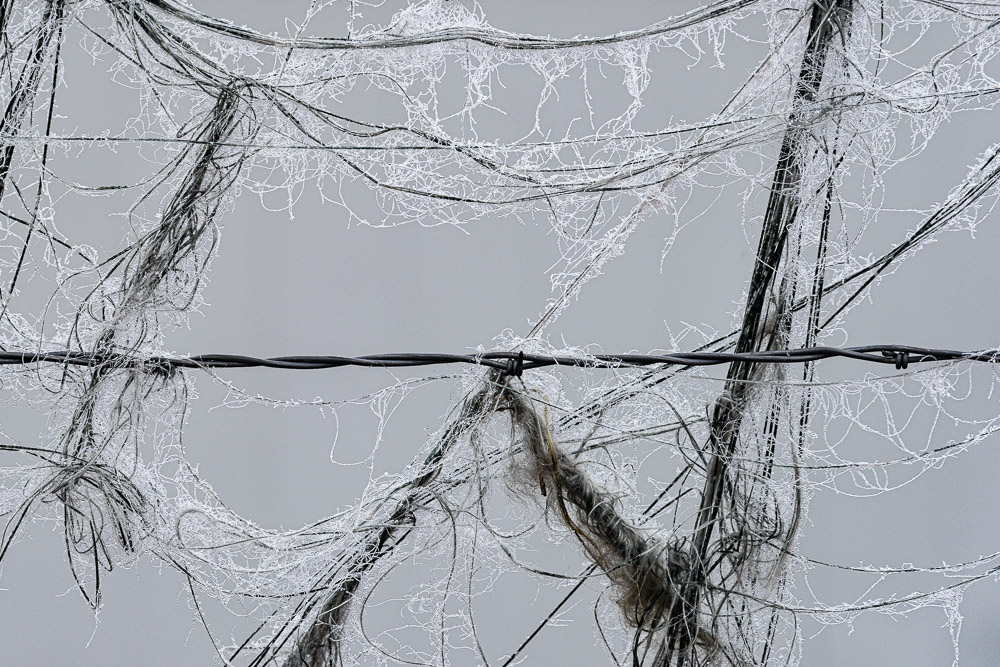
    The image at the top of this article was made less than 100 ft from my studio.