An artists journey

Category: Uncategorized

  • The Decisive Moment

    The Decisive Moment

    Henri Cartier-Bresson was well known for promoting the “decisive moment”. I know from experience that in some situations there is an optimum instant to capture the image you want. But for some it becomes a mantra. Let’s examine some nuances of the concept of a decisive moment.

    Sometimes it is not a precise moment

    Almost all of my work is shot outdoors. Sometimes I shoot straight landscapes. Often other found objects around me.

    I believe I have the experience to say that in these outdoor settings, the “decisive moment” may last from a second to many minutes. Or I may have to wait an hour for the moment to occur. In a slowly changing landscape scene it can be difficult to recognize which moment was decisive – and hope you had the presence of mind to capture it.

    In these situations, there may well be a decisive period of time, maybe not an actual moment. It often requires great patience rather than lightning fast reflexes.

    A decisive moment

    I have shot some sports and kids. These are areas with definite decisive moments.

    Sports is easier, in a way. Most sports have a rhythm, a pattern. Once you learn it for a particular sport, you can anticipate the action and predict the best moment. It still may be difficult and you may not be in the best position, but you often will know when it will happen.

    I consider kids more challenging than sports. They are unpredictable. Their moods and expressions can change quickly. Framing then, lighting them, and being in position with the right lens and camera settings requires constant attention. Then on top of all of that is the delicate trigger you need to “spring” at the right moment, when the expression or activity is just right. You have to be fully engaged and in the moment.

    I make it harder on myself, because I never do formal portraits where I try to control things. I greatly prefer being in the environment where they are comfortable and letting them basically forget about me. Candid shots are what I like.

    Now is the decisive moment

    This brings up one of the main points I want to make here: now is the decisive moment. Wherever we are and whatever we are doing, we should consider it a decisive moment. We need to be in this moment. Things will never be the same. We will never have exactly this light or these clouds. We won’t feel the same or look at the subject the same.

    This used to be a problem for me. I would see something interesting, but I was on my way to do something else “important”, so I didn’t stop. If I even remembered what interested me, it was usually not the same when I came back. The light was wrong. The vegetation had grown up and obscured it. It was raining and foggy. Just not the same. If I wait a couple of months before coming back, it may be a housing addition now!

    Well, it may still be a problem, but I recognize it and fight it now. I am much more prone to go ahead and stop and get the shot when I see it. If I am late to something, I don’t mind asking forgiveness. It has not become a problem, except maybe for my wife. She knows now to bring something to read, because I will stop at unpredictable times and places.

    Being mindful

    This all now brings us to the larger issue of mindfulness. Not the pseudo-spiritual mumbo jumbo we get from the self-help crowd. Real mindfulness involves being in the moment. Being fully aware and conscious.

    Modern society does it’s best to train us to not be mindful. We are constantly distracted and entertained. Other people’s ideas bombard us and lead us to pay attention to what they want us to do. But learning to think our own thoughts and to look around and actually see what is there is necessary and healthy.

    Do you walk down the street looking around and actually seeing what is there, or are you scrolling Facebook or email to make sure you don’t miss something? Where is your focus?

    Do you ever take time for yourself? To think, to consider things, to read? Not to think about work or politics or where you are going with your friends tomorrow night. Is the idea of being alone with yourself scary or exciting?

    I suggest you practice being alone in your own head. It might be hard at first. Give yourself some time to just think and to just look around, not expecting something – just looking. Making a quiet place in your head could be a welcome retreat in our noisy, distracting world.

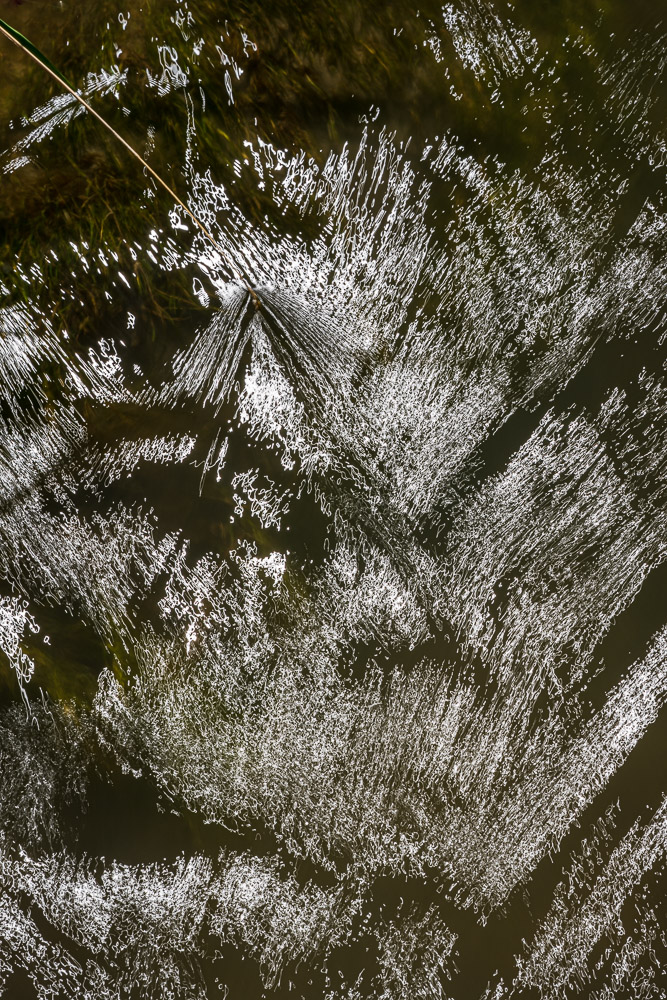
    The image with this post is a result of just being mindful. I noticed this scene on a walk along an ugly little canal in town. The location was not “pretty” in itself, but the conditions were right to make an image I love. I am very glad I took the time to notice it.

    Do you practice mindfulness? Let me know your experience!

  • Time

    Time

    Time is common to all of us. We are all given the same amount of time each day. Most of us are not as aware of time flowing by as we are of the events we have scheduled at certain times. Rather than moaning about how busy we all are or talking about productivity, I would like to discuss time as a creative element.

    What is time?

    Time is the continued sequence of existence and events that occurs in an apparently irreversible succession from the past, through the present, into the future.” Deep, but it helps frame the problem.

    We all “know” what time is, but we would probably have a difficult time describing or defining it. Yet it is what we live in. It controls almost every aspect of our lives. We all experience it constantly. We can’t control it or buy or sell it or save it. It flows on by with no regard to our desires.

    It may be a cliche that we all have the same amount of time each day, but like most cliches, it is very true. We can’t control it, we just decide what we are going to do with it.

    Most art deals with moments

    Most art, and most photography, captures discrete moments in time. This is the conventional view of the world. It is what we think we see all the time. Don’t take it as me sounding critical of capturing moments. I do it all the time, too. It records an event or a place or a person at a certain moment, and that matches and triggers our memories.

    In a sense, it is our way of freezing and controlling time. As photographers we usually think in terms of the best shutter speed to use to stop the action, to minimize blur. This is the right thing to do for normal image captures. We, and our viewers, expect the moment to be recorded in sharp detail with no distractions like blurred movement.

    Photography is unique

    Photography is unique in it’s ability to represent time in varying ways. Time is one of the variables of the photographic process.

    If you are painting or sculpting you usually represent what you can see or imagine. We seem to see things still, not moving or traveling through time. And it is very hard to imagine what the movement of time looks like. We may be able to see the effects of years or centuries on something, but even then it is impossible to visualize what it looks like as it is happening.

    But photography has time built in as one of the parameters being controlled. We balance aperture, shutter speed, and sensitivity (ISO) to determine an exposure. Think about that for a moment: we can adjust aperture and sensitivity to set the time window of an image to whatever we want. Within limits.

    Yes, we usually use this to set the shutter speed fast enough to freeze the motion. But that is just the normal convention. We could just as well make the shutter speed very long to observe motion over time. Some photographers do this regularly to feather moving water. It is almost a convention of landscape images, sadly.

    I know my friend Cole Thompson gravitates to very long exposures to give a different view of the world. Many of his images create very interesting effects.

    Movement

    I have recently found myself drawn to visualizing the passage of tiime.. More and more I tend to use relatively long exposures, often hand holding the camera, to examine the effects of movement over time. Some of my images done this way do not have a single sharp edge in them.

    This may seem controversial to many photographers. We are trained to maximize sharpness. We buy very high resolution sensors and ultra sharp lenses to record the sharpest detail possible. But I use those great sensors and sharp lenses to record – blur. A waste? That is an artistic judgment.

    One of the things I am trying to capture is the unseen way things move over time. We know they move. We can point to it and say “that is moving”. But it is nearly impossible to visualize what it really looks like as it moves. That is what I am exploring.

    The image with this article sort of illustrated this idea. This is an event called Cowboy Mounted Shooting. It is a speed and shooting event at some of our local rodeos. I believe the blur and slow shutter speed capture the speed and dramatic action of the event better than a crisp, frozen frame. The sharpest focus is on the face of the horse. That seemed appropriate to me because one of the things I wondered about is how the horse felt about guns going off over his head.

    A new viewpoint

    This concept is a new viewpoint for me. Time exposures are certainly not new and I have done a lot of them over my career. Now, though, I am more consciously using time as a creative element. Instead of a limitation of low light I now see it an an opportunity to show a new view on the world. I am working on a series that emphasizes this. Maybe more on that later.

    Time is too much of a subject to cover in depth in a blog post. It is a theme I will probably return to in the future.