An artists journey

Author: eoschlotz

  • Self-centered

    Self-centered

    If you describe someone as self-centered, that is probably taken as a negative. It often is, but there is another way to see it. If you are a “fine art” artist, I believe you have to be self-centered to really be true to yourself.

    Who do you listen to?

    It’s a problem these days that people are so “connected” to social media that it can be hard to maintain our identity. Is all your work instantly posted, tweeted, shared to “the world”? Do you measure your success by the “likes” or lifts or re-tweets you get?

    This echo chamber of voices can make it hard to listen to your own. If a significant number of your followers don’t like something you post, is it bad? As with any criticism, you have to try to be objective.

    These people giving you feedback – what do they know of your intent, your feelings, the direction you feel your art should go? What do they know about the process you followed to get there?

    Most pictures on the internet don’t get more than 1-2 seconds of attention. When someone hits the “thumbs down”, what does that mean? Is that a well reasoned, critical evaluation based on objective knowledge?

    Likewise, when most people gush over your post and give you glowing praise, what does that mean? Unless they are an artist who takes the time to look more deeply, probably very little. If they follow the praise with “and I will contact you to buy it,” that carries weight.

    Who should you listen to?

    The feedback of random people on the internet probably will not take you to where you need to go as an artist.

    Do you have a small set of trusted friends who will give you reasoned and honest feedback? If so, you are lucky. I desperately wish I did. Try to build such a group. If they really are good friends their honesty will be valuable for you, even when it hurts. If they really are good friends, they will hurt you occasionally.

    Do you work with one or more galleries? Ask them for evaluations, especially of your new work. I haven’t tried it, but I understand portfolio reviews can be good. Your mileage may vary, depending on which ones you choose. I know of successful artists who still go to them for the feedback. Read Cole Thompson’s portfolio review by Mr. X that changed his art.

    Are there artists in your area who you trust? Your style may be totally different and you may not even like what they do, but that is not the point. Can they give you objective and well reasoned feedback? Try to put a group together. I am looking to collect such a group in my area.

    Ultimately, though, it comes down to having to trust your own instinct. You are you. You are the artist. No one else can answer for you or decide what your style or theme or subject is.

    Can you be objective about your own work? Some people can, some can’t. Learn to. Since you are the only one responsible for your work, you have to be able to make your own decisions.

    Unashamed

    Sean Tucker used the term unashamed in a discussion of this problem in his book The Meaning in the Making. I think it is a good word choice. This is where the self-centered aspect comes in. It is understanding who we are and what we are trying to do, regardless of what anyone else thinks. Not arrogance but confidence. We have to realize that only we own our results and are responsible for our decisions.

    Anyone who does anything publicly will be criticized for it. That is true for us when we present our art to the world. A lot of people will hate it. Some will love it. The ones who don’t like it will be quick to tell us what is wrong and how to fix it or why we should quit. As an artist, we must be able to say “thank you for the feedback, but I am going in this other direction.” We have to believe it and in our self.

    Do you believe in you? Are you confident to the point of seeming self-centered? Good. Your opinion of your art is ultimately what matters. That doesn’t mean you will get rich or famous. But you will be at peace with yourself.

  • Finding Inspiration

    Finding Inspiration

    Are you empty sometimes? Are there times when you don’t have any ideas or new projects? We tend to desperately put pressure on ourselves to find something creative and new, but this is often counter-productive. So how do we go about finding inspiration?

    Relax

    Ouch. This can be hard. Our art is important to us. We need to be proactive and driven to produce. But first. relax.

    If you are in a slump creatively, just go with it. You will come out of it. But the more pressure you put yourself under the harder it sometimes is. It is very hard to force ourselves out of a slump. Our subconscious will eventually get re-engaged and start pumping out the great ideas. Give it time to rest and rejuvenate.,

    Take a walk

    Really. “Waste” the time. Carry your camera or not, it’s up to you, but don’t require yourself to take any pictures.

    When you walk, go slow. This is not mainly for the exercise. It is for your head. Look around. Look at everything. See things as it for the first time. Play the game that you just teleported to [your favorite exotic destination] and you are looking around in wonder at everything. Try to see how many things around your neighborhood you never really “saw” before.

    None of these may be in your “style” or preferred subjects, but learning to see new things is good.

    Read a book

    I have heard it said that most adults never read another book after they graduate from school. Maybe that is just males. 🙂 Even so, I hope that is a false statement. Books are one of the most important inventions in history.

    Reading something new will expand your thinking. Studying something related to your art will give you a new appreciation of different styles and ideas. It may teach you something you can apply to improve your images and refresh your creativity.

    Even if not, you will still be better off mentally for exercising your brain. Books are a major repository of the collected wisdom of centuries.

    Watch an educational video

    I can say to watch videos because I do not produce any videos. I’m not selling anything.

    The good thing about the internet is that there is a wealth of information there, free or for relatively low cost. There is probably no aspect of our art that someone doesn’t have a video about.

    That being said, the “signal to noise ratio” (the percentage of useful information) is fairly low. Be careful of who and what you take in. Even so, it is not too hard to find good stuff.

    If you are up to it, it can even be healthy to watch bad videos. That sounds weird, but do you find, as you get more mature and confident in your craft that you can sift the good from the bad? If you watch a bad video, or one you disagree with, it can be empowering to be able to refute the presenter and know why you believe they are wrong, at least for you. It can help bolster your confidence.

    Read other artist’s blogs

    You are reading mine. Thank you! I would love to hear your thoughts.

    Probably thousands of blogs are written every week. Pick a few new ones to add to your list. They do not have to be leaders in your field. Look around and find artists in other fields whose work you admire, who influence you, whose style you admire. Follow them. This is another great source of wisdom and inspiration.

    I follow a few people. Not many. But I am constantly amazed at the wisdom they give away.

    Be open

    None of these suggestions will do much good unless you open yourself to receiving what they might give. Openness is an attitude. Our attitudes are under our control.

    Are you totally focused on one subject? Why? Widen your view. Have you become cynical? As you learn to look around more, re-awaken your wonder and joy. Find new things that excite you. Cast a wider net. Get enthused about something. Give yourself permission to try new things.

    Inspiration sneaks up on us when we aren’t expecting it. The more we can be open and receptive, the more often we will find it. I find that stimulating my mind with new thoughts and learning new things helps keep me open to inspiration. Try it!

    About the image here

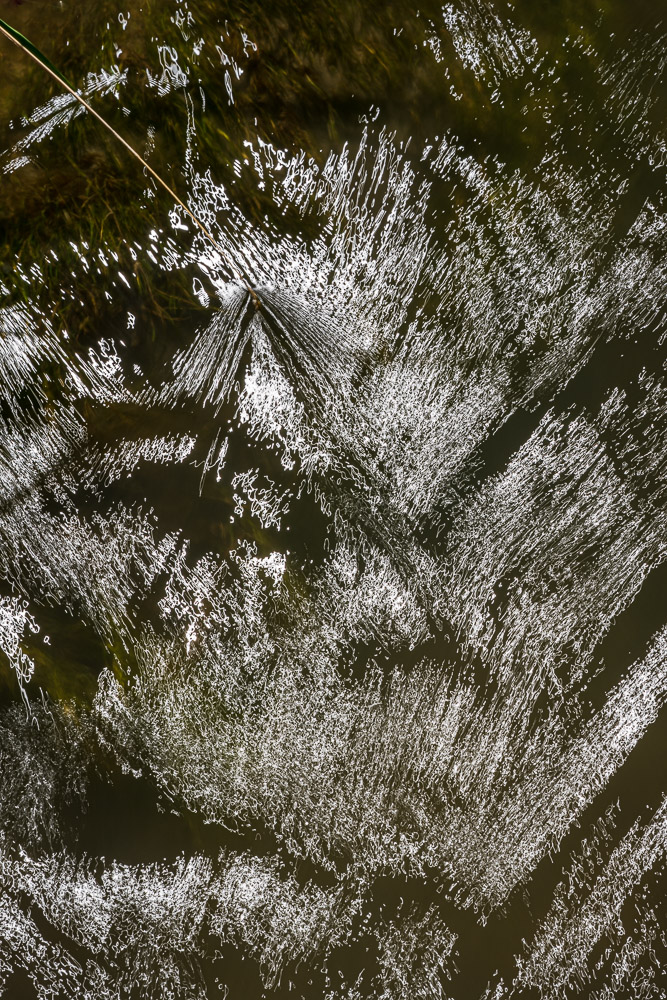
    I can’t claim this is super creative as such, but I am very happy I made this image. This is the epitome of depressing conditions: way out in the midwest, nothing around anywhere, temperature was 108F, winds blowing so hard I had to hold the tripod, totally clear blue sky – what to shoot? I decided the interest was the wind. How to capture the effect of it? I think, by being open to exploring new ideas, I made something good out of it. At least, I’m happy with it.

    This image is part of a series I am working on, tentatively called “Maria”. It is not published yet.

  • Black & White – in Color

    Black & White – in Color

    What? Isn’t that contradictory? Isn’t black & white is about the absence of color? I wanted to follow up on a previous article on how we get color information in our digital cameras with a nod to the purity of black and white and emphasize how it is still dependent on color.

    Remove the color filter?

    I indicated before that our sensors are panchromatic – they respond to the full range of visible light. If we want black & white images, shouldn’t we just take the color filter array off and let each photo site respond to just the grey values?

    We could, but most black & white photographers would not be happy with the results. It would be like shooting black & white film. A problem with black and white film is that it eliminates all the information that comes from color. Through interpolation of the Bayer data, we get full data for red, green and blue at each pixel position. If we removed the filter array, we would have only luminosity data. So before even starting, we would be throwing away 2/3 of the data available in our image.

    At that point we would have to resort to placing colored filters over the lens, like black & white shooters of old had to do. They did this to “push” the tonal separation in certain directions for the results they wanted. But this filter is global. It affects the whole image rather than being able to do it selectively as we can with digital processing. And it is an irreversible decision we would have to make while we were shooting. Why go backward?

    What makes a good b&w image?

    Black & white images are a very large and important sub-genre of photography. The styles and results cover a huge range. But I will generalize and say that typically the artists want to achieve a full range of black to white tones in each image with good separation. Think Ansel Adams prints.

    Tones refer to the shades of grey in the resulting print. We do a lot of work to selectively control how these tones relate to each other. Typically we want rich black with a little detail preserved in them, bright whites, also containing a little detail, and a full range of distinct tones in between. These mid-range tones give us all the detail and shading.

    Tone separation

    If one of the goals of black & white photographers is to have high control of the tones, how do we do that? Typically by using the color information. I mentioned putting colored filters over the lens. This was the “way back” solution.

    Landscape photographers like Ansel Adams often used a dark red filter to help get the deep toned skies they were known for. Red blocks blue light, forcing all the blue tones toward black.

    Digital processing gives us far more control and selectivity than the film photographers had. We don’t have to put the filter over the whole lens and try to envision what the result will be. We can wait and do it on our computer where we have more control, immediate previews, and undo. But all this control would be impossible without having a full color image to work with. As a matter of fact, modern b&w processing starts by working on the color image. Initial tone and range corrections are done in color. Good color makes good b&w.

    B&W conversion

    Obviously, at some point the color image has to be “mapped” to b&w. This is called b&w conversion. It can be a complicated process. There are many ways to go about the conversion, and each artist has their own favorites. There is no one size fits all.

    It is possible to just desaturate the image. This uses a fairly dumb algorithm to just remove the color. It is fast and easy, but it is usually about the worst way to make a good b&w image.

    You could use the channels as a source of the conversion. The RGB colors are composed of red, green and blue channels. These can be viewed and manipulated directly in Photoshop. They can often be useful for isolating certain colors to work on. Isolating the red channel would be like putting a strong red filter over the lens.

    Lightroom and Photoshop have built in b&w conversion tools. In LIghtroom, choose the Black & White treatment in the Basic panel of the Develop module. This has an interesting optional set of “treatments” to choose from in the grid control right under it. In Photoshop use the B&W adjustment layer.

    Both of these have the power of allowing color-selective adjustments. This is huge. Tonal relationships can be controlled to a much greater degree than was possible with film. If we want to just make what were the yellow colors brighter, we can do that. Of course, Photoshop allows using multiple layers with masking to exert even more control.

    There are many other techniques, such as channel mixing or gradient maps or plug-ins like Silver Effects to give different and added control. It is actually an embarrassment of riches. This is a great time to be a b&w photographer.

    It starts with color

    What is common to all of this, though, is that it starts from the color information. Color is key to making most great black & white images.

    I sometimes hear a photographer say “that image doesn’t work well in color, convert it to b&w”. Sometimes that works, but I believe it is a bad attitude. B&w is not a means of salvaging mediocre color images. We should select images with a rich spread of tones, great graphic forms, and good color information allowing pleasing tonal separation. Black & white is its own special medium. Remember, though, usually it requires color to work.

  • Wonderment

    Wonderment

    Do you still have a sense of wonder? Can you get excited by simple, ordinary things around you? If yours has faded I hope I can refresh your excitement and help you redevelop wonderment.

    It came built in

    When we were small, most of us had this wonderment. Everything was new and fresh and exciting. An ice cream cone, a kitten, a flower, a ball, a bicycle – they all captivated us. We could go out and play all day with a cardboard box.

    But then somewhere along the line, we “grew up”. It is what we were supposed to do. At least, that’s what they said. We became too “mature” for that child-like wonder. Cynicism replaced wonder. Boredom chokes out the joy we had.

    Are our lives better off based on cynicism? Perhaps we should try to recapture some of what we had. I believe we can relearn some of this joy and wonder if we work at it.

    Change the context

    Most of us lead pretty routine, repeatable lives. Making a change to the routine can wake up new ways to see things. Go out for walk. Get up earlier. Sleep in later. Instead of going to one of your normal restaurants fix a picnic and go to a park. Stop and look at a sunset. Really look.

    See a road you haven’t been down? Take it. See what’s there. It will probably only take a few minutes, but you expand your viewpoint and feed your curiosity. It’s worth it to me. Even is it is ugly and awful and seems to be a waste, I believe you are better off for breaking the routine and trying it.

    Feed your curiosity

    Are you still curious? I ask seriously. Many people don’t seem to be curious about the world around them. I think that is part of the cynicism that shuts down the desire to know more. For some it is enough to try to decide what’s for dinner and which TV show to watch.

    If you are reading this blog I hope that is not you. I hope you burn with curiosity about a variety of subjects. Let that drive you to do something. Look it up. Build something. Try something new. Read a biography of someone you admire.

    Let me give a small example that is completely off topic from art, but relevant to the idea of curiosity. My city is installing fiber to the house broadband throughout the town. So for months there has been strange equipment around putting the conduits underground. I was curious about how that worked so I looked up some articles on horizontal boring. It is pretty fascinating. It is a much better way of installing pipes in areas where there is already a lot of utilities in the way. Now when I see this equipment I have a better idea of how it works and I feel better for taking the time to satisfy my curiosity.

    I believe curiosity goes hand in hand with our sense of wonder. They each support the other. As you let your curiosity grow and feel its way in different directions your wonder will grow at what you are discovering. And your wonder encourages you to be more curious.

    Slow down

    Slowing down can be hard for us. The world pushes us forward at breakneck speed. Faster, be more productive, multi-task, don’t slack off.

    But slowing down sometimes (and unplugging from media and social networks) can be very good for us. When we take it slow for a change we see new things. We see things in new ways. Let your mind rest and catch up. Give it some time to relax and think.

    And like changing the context, slowing down allows us to see things different. Instead of flashing by with little thought we can take a new look at things around us. Start to really see. Seeing leads to wonder.

    One of the things I love to do is show someone a picture and have them say “that’s pretty neat, I’ve never seen that before.” And I point out to them that it is a block from where they are and they’ve passed it 100 times without seeing it. Some people are insulted. But some learn from that that there are interesting things to see all around ir you are receptive.

    Travel

    This is an easy one. Travel takes us to new locations, out of the norm, maybe out of our comfort zone. This is good. Things seem new and different, and for a while we tend to look around more.

    It has always been said that travel is broadening. I agree. The change in perspective and environment and getting out of the usual can be very good for us. One of the hard things is to bring this awakened viewpoint back home. We so quickly fall back into our ruts.

    You have control of your attitude. Come back from the trip with a commitment to see your local area as if it was an exotic destination. Sounds silly, but try it.

    it’s an attitude

    You control your ability to find wonder around you. It is an attitude and something you can practice to improve. Like learning any new habit, it takes time and hard work.

    First, you have to decide that a new sense of wonder is worth it. It might take a while to rediscover that spark and recognize it. Then you have to practice finding it. Then you have to keep on pushing yourself to keep looking with fresh eyes, even when everything seem so boring.

    Be open to it

    Wonderment is really something we find within ourselves. We have to look inside and discover that we are curious and new things we see and find can be exciting and worthwhile.

    Climb out of your rut. Take a fresh look around. See with new eyes and a new attitude. Practice, practice, practice.

    Somewhere inside is still some of that child-like wonder we used to have. When we bring it out again we have a fresh and exciting life. Be amazed.

    Note on the photo: This is a perfectly common and ordinary scene where I live. You would probably walk by it with barely a glance. I have changed it in ways that makes it abstract and difficult to recognize, and to me, it exudes wonder.

  • What the Camera Sees

    What the Camera Sees

    One of the important things every photographer has to learn is to see what the camera sees. It is a different process from painting or other visual art. It is a technical process, not only of how the sensor works but the transform of a 3 dimensional world to a 2 dimensional representation. This is part of our art. We have to understand it and be able to predict the results.

    Static image

    Unless you are shooting video, the end result of the camera’s capture is a static image. That seems like a “duh” to most of us, but it is significant. The entire image is recorded “in one instant”. Yes, I’m ignoring moving shutter slit, HDR, panoramas, time exposures, and other exceptions that can bend the rules.

    This “in one instant” is significant because our eyes work in a totally different way. We can only see a small spot at a time. We continually “scan” around a scene to “see” it all. Our brain stitches all these scans together marvelously to give us the impression of a complete scene. We are not aware of it happening.

    What difference does it make? Well, there are subtleties. If something moves in real life, our eyes jump to the movement and study it. Movement has a higher priority in our brains than static things.

    Our photograph no longer has that movement or flashing lights. It is a flat and static collection of pixels. We have to learn techniques to stimulate the viewer’s eye in other ways. We learn that the eye is drawn to the brightest or highest contrast areas. That informs how to capture the scene and process it to end up with results that help direct our viewer to the parts of the image we want to emphasize. It helps a lot to anticipate what we are going to want to do. This is part of learning how the camera sees.

    Depth of field

    The static image we create may or may not seem in sharp focus throughout. This is known as depth of field. It is referring to which parts of the scene are in “acceptable” focus. The aperture setting controls the range of this good focus area.

    Remember that the 3 main things controlling the exposure of an image are the aperture, the shutter speed, and the ISO setting. The aperture controls the amount of light coming through the lens at any instant. How long the sensor is exposed to the light is the shutter speed. And the ISO setting is the sensitivity of the sensor to the light. A side effect of the aperture setting is the control of effective depth of field.

    In real life we do not see limited depth of field. Our eyes focus on one small area at a time. Each spot we focus on is in sharp focus. The resulting image our brain paints is that everything is in focus. Try it. Look around where you are now. Then close your eyes and try to remember which parts were out of focus. Spoiler – there aren’t any. We remember it all in focus.

    So this is a big disconnect between what we perceive of a live scene and what we record in a photograph. Some photographers see this as a problem if they cannot keep the entire scene in sharp focus. But intentionally making non-subject areas blurry can also be used for artistic effect. Since this is different from how our eyes see, this creates something that stands out. It can change our perception.

    But like it or not, it is something that the camera sees differently and we need to learn how to handle it.

    Shutter speed

    To our eyes, things seem to be either frozen sharply or “just a blur” moving by. Things are usually only perceived as a blur if we are not paying attention to them.

    But for the camera, the shutter is open for a certain amount of time and things are either sharp if they are still or blurred if they are moving. The camera does not understand the scene and it is not smart enough to know what should be sharp.

    Let me give an example. Say you are standing beside a road watching a car go by. If we care about the car (wow, a new ______; that would be fun to drive) we are paying attention to it and we perceive it as sharp. To the camera, it is just something moving through the frame while the shutter is open. It has no name or value. The photographer has to determine how to treat this motion. What it should “mean”.

    So the photographer may pan with the car to make it appear sharp while the rest of the image is blurred. Or the intent might be for the car to be a blurred streak in the frame. Either way, it is a design decision to be made because the camera records movement differently from us.

    The lens

    Unlike us, our cameras let us swap out a variety of “eyeballs” – the lens. We have a certain fixed field of view. That is why camera formats have a particular focal length designated as the “normal” lens. For a full frame 35mm camera like I use, the “normal” lens is in the range of 45-50mm, because for this size sensor this corresponds to the field of view we typically see.

    But most of our cameras are not limited to that. We can use very wide angle lenses to take in a larger sweep of scene. Or we can use a telephoto lens to bring distant subjects close or to restrict our view to a narrow slice. Or we can use macro lenses to magnify small objects. All these things give us a new perspective on the world that would not be possible with our regular eyes. This is another way the camera sees that we need to learn to use.

    Mapping to 2D

    The world is 3D. Pictures are 2D. It seems obvious. Yet we must be aware of the transformation that is happening.

    In the 3D space we move in, we are acutely aware of depth and movement in many axes – length, width, height, pitch, roll, yaw, and others. We use this information automatically to interpret the world. But it is lost when the scene is captured on our 2D sensor.

    We sense depth. “In front of” or “behind” come automatically to us. Our camera is not as smart. The camera sensor records everything in front of it as a flat, static image. The scene is mapped through the particular perspective of the lens being used and onto the flat sensor.

    An example to illustrate. This is a classic. You take a picture of your family downtown. The scene looks perfectly fine and normal to you, because you intuitively realize the depth and separation of things. It gives you selective attention. But when you look at the picture there is a very objectionable telephone pole poking out of Uncle Bob’s head. You did not pay attention to that at the time because you “knew” the pole was far behind him and you dismissed it. The camera doesn’t know to ignore it. All pixels are equal.

    Light

    This is fundamental to our cameras. There has to be a light source. The camera sees only light from a source or light that is reflected or transmitted by objects. But being humans, we interpret the real world as objects. They are “there”. They have mass and form and value and color. Not so to the camera. It doesn’t ascribe meaning to a scene. All a camera can record is light. Our fancy sensor doesn’t see a red ball. It detects, but doesn’t care, that there is a preponderance of light in the red band being recorded.

    By its very definition – photo-graphy means writing with light – photography is dependent on light. Our modern sensors are marvelous products. We can shoot at very high ISO and make exposures in almost total darkness. But if any image was recorded, there was some actual light available.

    Everything in every image we make is a record of light. More than almost any other art form, photography is dependent on light. Photographers must be intensely sensitive to the direction and quality and color of the light sources that are illuminating our scene. Likewise we must be very aware of the objects the light is falling on, their shape and texture and reflectivity and color.

    Learning to see, again

    Art in general, and photography in particular, is a lifelong learning. We learn to see creatively. We learn to see compositions and design. And we have to learn to see the way the camera sees. This is the way we capture the image we want.

    Note, after writing this I found this good article by David duChemin. He is a great writer.