An artists journey

Category: Creative Ideas

Ideas about creativity and the creative process.

  • Acceptance

    Acceptance

    Some people are detailed planners for a shoot. Some go out with an attitude of acceptance, ready to work with what they find. Which is best?

    Planning can achieve great results

    Some people love planning and are good at it. I will totally admit that there are occasions where it is necessary and appropriate.

    Chris Weston (sorry, this is a subscription site; I asked, but they could not provide a way for me to give you access to this lesson for free) tells of a time on assignment when he had a very special shot in mind. Lions hunting at night under the stars. By planning it out in detail, even sketching the final shot, he knew what lens to use, how many flashes to use and where, where to set up, and what direction to aim the camera to get the milky way positioned as he wanted. It worked and he got his desired shot. But even then it took 6 days. Not because it took many tries to get it, but because he had to wait for the new moon so the stars would be optimum.

    It was a unique and interesting shot. I applaud his persistence and hard work. Yes, and even his planning. But it is not the way i work. I don’t do National Geographic or book assignments where a certain result is needed. I accept the scene I’m given and try to make it the best I can.

    Mountain lake at sunrise©Ed Schlotzhauer

    Not negative

    Acceptance may be a negative word to some people. It could imply a type of fatalism. A form of low standards and values, where you are willing to settle for anything. Like, you are not worthy. Or you are not the kind of person who should expect to receive good things. Or maybe it’s not worth trying for something better. Poor me. Eeyore.

    Don’t go there. I encourage you to take a different meaning. View acceptance as a kind of peace and contentment. In the context of photography, I mean it to be a mindful encounter with our subject or scene. One where we are willing and able to look at it honestly and evaluate it for what it is. Once you accept it, you can more fully see its story. You might discover something unexpected. And you are free to reinterpret it according to the story you want to tell with it. But it is important to get our biases out of the way first.

    Seeing it for what it is releases us from assumptions and expectations that could hold us back. We see the flaws, but also the possibilities.

    Dead tree in snow. Bent, broken, but still trying to stand.©Ed Schlotzhauer

    Acceptance gets more results

    I hear people complaining about not getting the great shot they had planned because conditions were not what they anticipated and planned for. Some astronomer friends of mine spent a year planning a trip around a solar eclipse. When they got there, it was cloudy. There was nothing else they wanted to photograph. That is sad. I empathize with them, because it has happened to me.

    I sometimes still go out with expectations in mind. That is a trap, but it is natural and I’m not immune. For example, it being winter here as I write this, I went out shooting today with images in mind of nice ice shapes along the river. Well, it snowed a couple of days ago and most of the ice is covered up. And it is warmer today and some of the ice has melted. Not what I had in mind.

    Having a fixed expectation in mind is like a filter. Our mind obediently screens out everything else that is not what we are looking for. So we are disappointed because we did not see any good picture possibilities.

    But there’s a different reaction we can take to a situation like this. We could say to our self “Bummer, the conditions I wanted are not there. But let’s see what is there and what I can do with it.” I believe if we take a mindful attitude we can discover new points of view, even on an iconic scene.

    Accept what you see and make your images to the highest level of quality you know how to do. Compose each frame as if it was the most important image you have ever shot. It might be.

    And peace

    A hidden benefit of having an accepting attitude is that it can bring us peace and joy. Rather than getting frustrated and walking away we can launch into a productive session exploring what we discover. We turn disappointment into joy and contentment. Most likely, we come away with unexpected images we like. Some may even make it into our portfolio.

    Happiness springs from a clear-minded engagement with the present moment

    Gary Buzzard

    Changing our attitude and turning a disappointment into a joy is a good thing. Even if the pictures aren’t great, isn’t the good feeling worth it?

    This is a benefit I don’t hear talked about for mindfulness. When we are mindful, we are looking for the opportunity, the good, the fresh. That is beneficial to our life and attitude.

    And we can get some interesting pictures.

    So is detailed planning or spontaneity best? That’s up to you. It depends on your personality and your needs. But whichever you choose, I recommend keeping a mindful attitude of acceptance. You will enjoy yourself more and discover some new images you did not have in mind.

    An interpretation of my feelings for Trail Ridge Road©Ed Schlotzhauer

    Today’s image

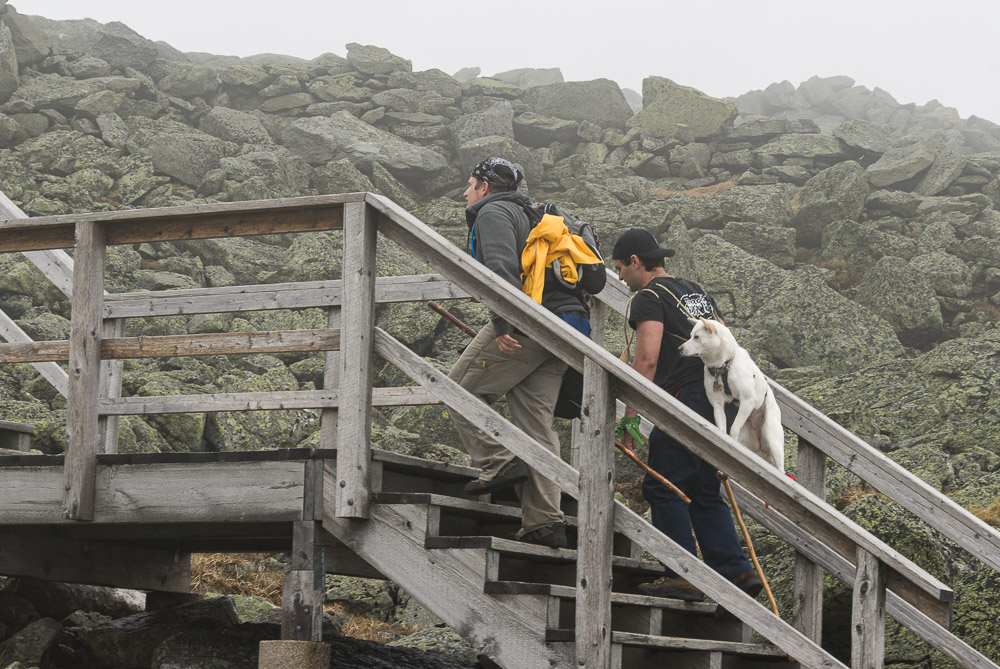
    This is an example of lemons to lemonade. We were on top of Mount Washington. I guess it was fairly typical weather for there. Completely socked in by clouds. So windy we could barely stand up. Not good photography weather.

    We were going to walk the last few feet up to the top, but conditions were so bad that I decided to not even to take my camera. Then I saw this, ran back to the car – still close luckily – got my camera and was only able to get this one shot.

    I don’t know the story. I don’t understand why it is happening. And still, years later, I wonder about it. If you know of a reason to have the dog hung on his back, please let me know. But it is one of those images i remember.

    Side note: after that, I took the camera to the top. The clouds broke for moments and I got some shots I liked. Don’t ever leave your camera behind.

  • Staying Creative

    Staying Creative

    Since you are reading this, you probably call yourself a “creative”. That is great. But creativity seems to be cyclic. Staying creative is a continuous process. Some would say a struggle.

    Cycles

    Creativity is not a constant level. We experience creative peaks where exciting new work seems to burst from us. But we also have low points. In those troughs we don’t feel like we can generate any creative ideas. It is depressing and scary.

    The encouraging reality is that this is normal. We do not and cannot operate at a peak of creative output all the time. We empty the tank. The reserve has to be refilled. It can’t be predicted or planned, but at some point it seems to dry up. But keep in mind that we really do not know what creativity is.

    We know it is cyclic. And we know it will come back at some point. But when we are in that valley it can seem like a time of doom and gloom. Will it ever come back? Have I used up all the creativity I had and now I will never have any again?

    You have thought these things. Admit it. I’m not the only one with these fears.

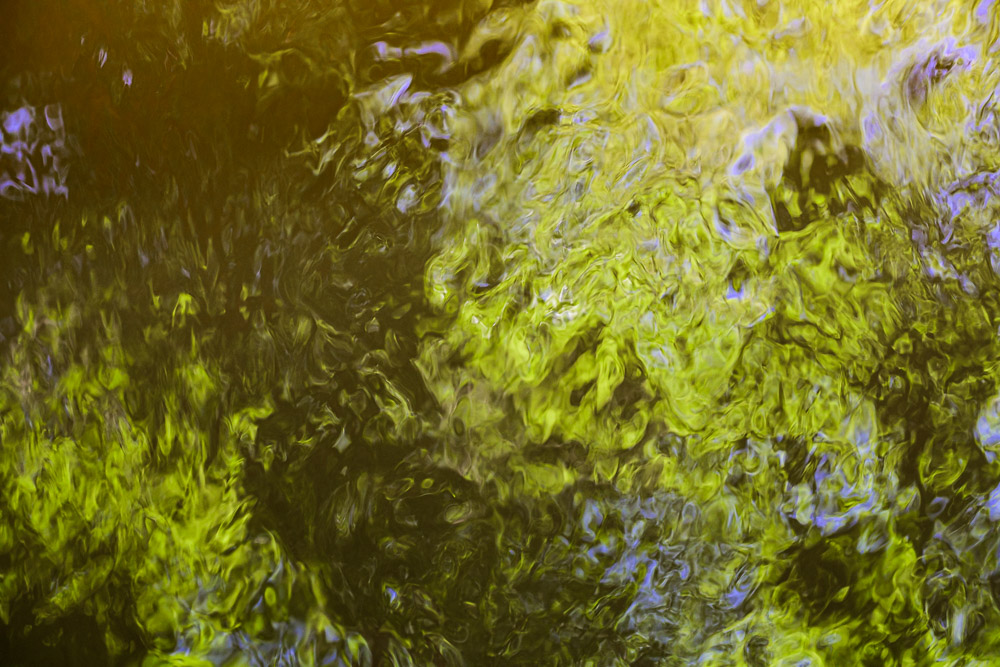
    Tennessee Stream©Ed Schlotzhauer

    Forcing creativity

    So what do we do? At some point we often resort to forcing it. We are determined to regain our creative highs, so we try to make our self create.

    How does that work for you? Probably as poorly as it does for me. Sure, we can do some good work, even very good work. But we can’t kid ourselves that it is up to the level of our best.

    Whatever it is in us that generates creativity operates on its own schedule. It is not sympathetic with our wishes. We can be welcoming and encouraging to it, but it does not operate at our command.

    Do something

    Now I will seem to contradict what I just said, but I do not believe it is a conflict. We will get through a creative valley easier and probably faster if we work through it. I used the idea of “emptying the tank” of our creativity. I believe practicing our craft and following our curiosity are very good behaviors to help refill it.

    You may not be inspired with amazing new creative ideas, but go out and see what you can find. Explore. Do not expect to do your best portfolio work. Taking that pressure off will help you relax and lean into it. But doing something is better than sitting around moping.

    It is a wonderful time to learn new skills, take some courses or watch some videos. Pick out some new technique you have been curious about and learn it. Practicing it now without all those creative bursts getting in the way is a good time to learn. It is a great time to explore some of those dark, scary corners of Photoshop that have intimidated you for a long time.

    Like most of life, doing something is better than doing nothing. Don’t sit feeling sorry for yourself, thinking you are useless and have no more creativity. Fill. your time with learning, exploring, practicing, experimenting, even catching up with cataloging your images. And always follow your curiosity.

    The word “create” is a verb. Be active. Go make things. Make dinner, make a drawing, make a fire, make some noise, but make. If all your attempts at being creative consist of passively consuming, no matter how brilliant what you consume is, you’ll always be a consumer, not a creator.

    Scott Berkun, in The Myths of Innovation

    An un-pre-visualized shot taken from a moving boat on the Seine River.©Ed Schlotzhauer

    Relax

    When creativity seems to slip away, when the muse no longer is with us, relax. It does not mean it is gone forever. Like waves, there are highs and lows. It will come back.

    Even when we are not feeling inspired, we can keep on working and learning. Do not be passive and waste your time. Be preparing for the rush of creativity when it comes.

    We are not a failure when it seems we cannot create astounding new things on command. We are recharging. Accept it. Go do your work anyway.

    Have you done creative work you are proud of? Then you should be able to do it again when you are ready. Creativity is not a limited resource that is used up. When you are feeling it, pour it out on everything you do.

    Let it flow

    Being in a flow state is a great feeling. But it is not exclusive to feeling creative. Anytime you are immersed in applying your skill to a difficult and challenging problem you can be in flow.

    Flow and creativity, then, are not synonymous. We can do great work even when we are not riding the crest of creativity. Don’t stop working.

    Curiosity is the thing that pulls us along through life and through our art. It does not come and go like creativity. In that way, it is more powerful than creativity.

    The cure for boredom is curiosity. There is no cure for curiosity. – Dorothy Parker

    I like that idea that there is no cure for curiosity. I don’t want to be cured of it.

    We can develop our curiosity by asking questions and wondering about things. Give yourself permission to follow your questions. Find the answers. Try things. See what happens. This healthy attitude will carry us through the ups and downs. Creativity may come and go, but our curiosity goes on and gets stronger.

    So, even if you feel that your creativity has evaporated, trust that it will return again, just like it has in the past. While you are waiting, keep photographing, learn, practice, experiment, and especially, feed your curiosity. You might find that the extra kick of creativity is actually just an incremental boost to the power of your curiosity.

    The artist is nothing without the gift, but the gift is nothing without work. – Emile Zola

    An unexpected travel shot. It came from taking the time to stop and watch and wait.©Ed Schlotzhauer

    Staying creative

    So, as far as staying creative. You won’t always be at your peak. Sometimes you may feel way down in the valley. Don’t panic. It will come back. In the meantime, there are things you can do to improve yourself as an artist and a person and to entice the creativity back. Work on your curiosity. Explore new ideas and techniques. When you feel the creativity flowing again, you will be even more ready to use it.

    But no matter what, keep working.

    Today’s image

    Sunset downtown. I turned my view down to the parking lot instead of out at the glowing buildings. Is this creative? Or is it just following my curiosity? I don’t know. I will leave that for greater minds to decide. Either way, I was letting it flow.

  • Take a Cheap Trip

    Take a Cheap Trip

    Most of us like to vacation. Travel is booming at levels not seen for years. Popular vacation spots are often overcrowded. And costs continue to increase. What if I suggested a way to take a cheap trip? One that may benefit your photography. And it’s not a timeshare sales pitch.

    High costs

    Travel inflation seems to be higher than other inflation in general. It restricts some of what we can do.

    A trip overseas for a few weeks can be out of reach, both in money and the time required. It can suck up our entire savings for a year or more. Even taking a local road trip is getting to be a burden and out of reach for some of us.

    But some of us rely on travel to refresh and relax us. What are we to do?

    Antique narrow gauge steam locomotive snowplow©Ed Schlotzhauer

    Why do photographers travel?

    Photographers seem to have a special fondness for travel. We expect the travel experience to renew us, shake out the cobwebs, invigorate our vision and interest. And we want to come back with exciting new images to show and talk about.

    This has long been the case. From the beginning photographers tended to travel.

    As soon as the technology allowed fairly portable equipment, it seems like photographers were traveling. Matthew Brady traveled and photographed extensively during the American Civil War. Other famous artists like William Henry Jackson and Ansel Adams shot exclusively outdoors. And I’m just highlighting American photographers.

    These artists traveled to places most people couldn’t go in those times. They opened up our understanding of the world and what was going on. In this, they did a great service.

    Our travel expectations are probably more modest. We will seldom go to uncharted lands no one has ever seen. But we go to places new to us. Or at least places outside of our normal routine. It is enlightening and changes our perspective and understanding. That is usually a good thing. And refreshing.

    I think a yearning to travel is an inherent part of society these days. Especially for photographers.

    Shake it up

    But I promised you a cheap trip. Here goes: shake up something you usually do.

    Yes, that’s it. That’s all.

    We all fall into ruts. Shooting the same subjects in the same way with the same lens in the same lighting. It becomes a habit. A habit is where we avoid thought and go through life on automatic. Shake that up by changing something. Force yourself to confront a different situation where we have to think.

    One simple thing is to pick one lens we seldom use and photograph exclusively with it for a while, say a month. Some of us are naturally wide angle shooters. Switch to a telephoto. Some of us see only telephoto shots. Switch and only carry a wide angle for a while. Or a macro lens and only shoot closeups. Or a fish eye, or a tilt/shift. If you are a landscape photographer, try street photography. If you do portraits, try night skies.

    And yes, just carry that one lens. Not your whole kit. It will force you to play the game.

    Maybe try putting aside your “serious” camera for awhile and only use your phone. Or shoot with the expectation that you will process everything to black & white. Maybe it could be as simple a thing as deciding everything you are doing now will be cropped square.

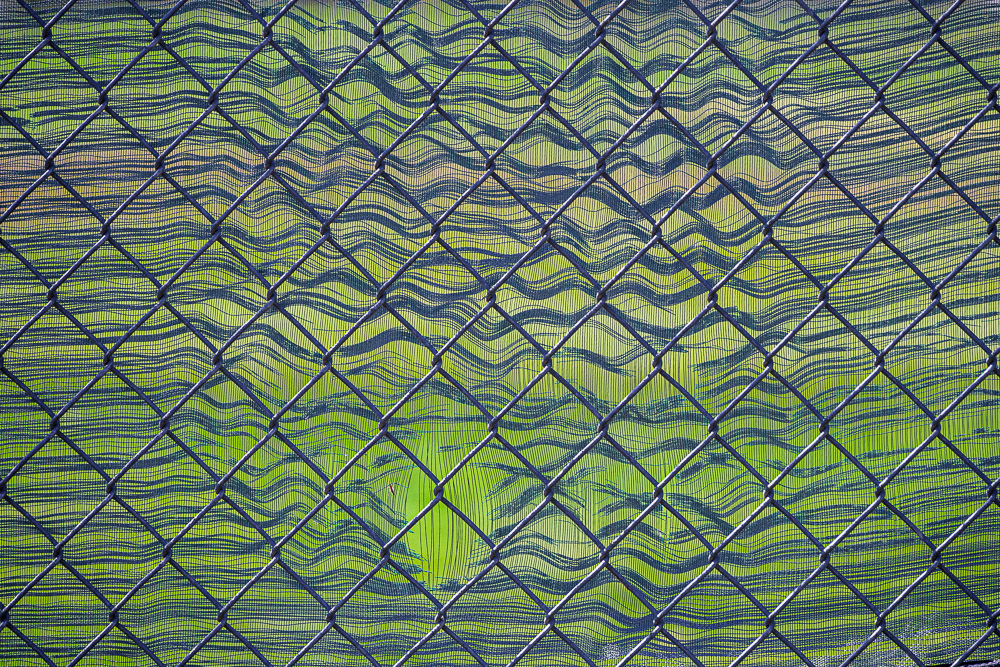
    Chain link fence with frayed cloth©Ed Schlotzhauer

    Just do something different

    It really does not matter what you choose, as long as it is different enough from what you usually do. During this time you are not concentrating on adding to your portfolio. The goal is to break free from your normal habits and learn to see better. Think again.

    How is this a cheap trip? Travel encourages us to see different. We are out of our comfort zone. We become more mindful. Basic assumptions have to be re-examined. Things look new and different so we pay more attention to them. Making a change in our routine triggers similar things.

    One way to simulate that same effect as travel to force our self out of our normal rut. A cheap and easy way to do that is to force a change in how we see through our camera.

    Sound too easy? Try it. You may be surprised.

    Practice mindfulness exercises

    Making a change like this is one example of a mindfulness exercise. I’m not talking about chanting and navel gazing. The purpose of mindfulness is to set aside our preconceived notions and expectations. Wall out the distractions that are enticing us to other things. Learn to be in the moment, and to look around and actually see what is there.

    Some people can get there through meditation. Some others through travel or workshops. Maybe for you going to a museum and looking at the work of great masters does it. But regardless of the mechanism that works for you, mindfulness comes down to creating a still place for yourself. A place where you can set aside distractions and competing thoughts for a while. Where you can free yourself to really see and consider what is around you for what it is. Where you can immerse yourself in the experience of creating.

    In a canal©Ed Schlotzhauer

    A cheap trip

    I am not really joking when I say changing up your normal routine or environment occasionally is a cheap trip. It can produce some of the same benefits we often get from travel. Granted, it may not be as much fun, but it is a lot cheaper. And you can do it anytime or anywhere.

    No, I’m not suggesting that this is an excuse to go buy that great new lens you have been wanting. Of course, whatever excuse works for you is up to you. But that shoots down the idea of a cheap trip.

    Getting out of our normal territory and traveling to a new location often puts us in a more mindful attitude as we shoot. It amazes me that everything we see becomes an interesting subject. Part of that is because we set aside the uninterrupted time to be there and shoot. But I believe a large part of it is that we are seeing things new. That refreshes and energizes us.

    I am suggesting another way to stimulate a similar effect of travel is to change something about our routine. Something to make us think, reconsider, focus more on what we are doing. Something to make us see past mechanics and rules of composition and social media likes.

    Make it a habit to challenge yourself like this periodically. It does not require an uncomfortable 10 hour plane ride.

    Today’s image

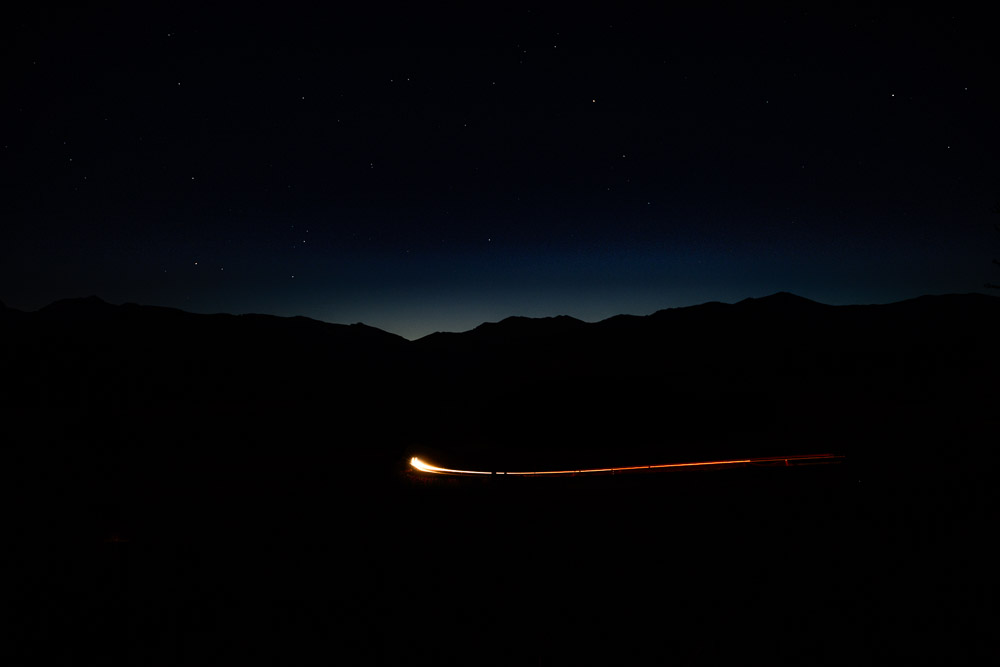
    The image at the top of this article is an example of shaking myself out of a rut. This was taken in the Rockies in fall. Normally during this time I am concentrating on beautiful fall colors and aspen trees.

    In this case, I tasked myself with ignoring the leaves and shooting the mountains after dark. No trees or fall colors visible. This is the Eisenhower Tunnel from the Loveland Pass road. Stars are just becoming apparent as the last light fades, illuminating the mountain silhouettes. The trail of lights in and out of the tunnel adds unique interest.

    I felt good about it. Definitely not a conventional fall landscape.

  • Get in a Flow

    Get in a Flow

    You have probably heard of flow states. Maybe you have experienced it. It is a wonderful place to be. Let’s talk about what it means to get in a flow. It does relate to art. Trust me.

    What is it?

    The concept of a flow state was described by Mihaly Csikszentmihalyi. Good luck with the pronunciation. It is actually fairly easy after you hear it.

    Csikszentmihalyi was a child in Eastern Europe during WWII. It was a deeply traumatizing experience. And he noticed that, even after the war, many people were not able to recover mentally. He was very curious as to why.

    Eventually he moved to America and studied psychology. His main research focus was happiness, what it is and how to achieve it. The identification of what we now call flow was a minor part of this research. He found that people were their most creative, productive, and happy when they were in this flow state.

    In Csikszentmihalyi’s words, flow is “a state in which people are so involved in an activity that nothing else seems to matter; the experience is so enjoyable that people will continue to do it even at great cost, for the sheer sake of doing it” (1990).

    He discovered that flow was a state people could get into temporarily where amazing and beneficial things happened. They had almost complete concentration on their task. Time would seem to speed up or slow down. The activity they were doing was intensely rewarding and pleasurable to them. And there seemed to be effortless ease in what they were doing.

    Who experiences it?

    Different people have differing predisposition to get into flow states.

    Autotelic personalities tend to experience more flow. An autotelic is someone whose personality is driven by internal rewards more than external motivations like money or power. They are creative and curious and independent. This leads them to pursue goals that motivate them and give them internal satisfaction.

    At the other extreme, people with a neurotic personality find it difficult to get into flow. Some think this is because their anxiety and self doubts inhibit the conditions leading to flow.

    What happens to the brain?

    Many researchers approach the study by trying to identify the mechanisms in the brain that support flow. I don’t have much interest in looking at it this way, but I will note some of the thoughts.

    Some believe there can be an interaction between the default mode network (DMN) and the executive control network (ECN) in the brain. The DMN is the background processing we do, as when we daydream. The ECN is most active during problem solving and it helps tune out distractions. They feel that when these 2 centers work together in the right way we can achieve flow.

    Another theory attempts to show that flow is achieved through expertise and practice. The idea is that as we become expert at certain tasks and reinforce that through repeated practice, we train the brain to perform it more effortlessly. The brain can sort of turn in to an automatic mode and let go and let the creativity flow.

    This second research seems to be “winning”, and it is what I subscribe to.

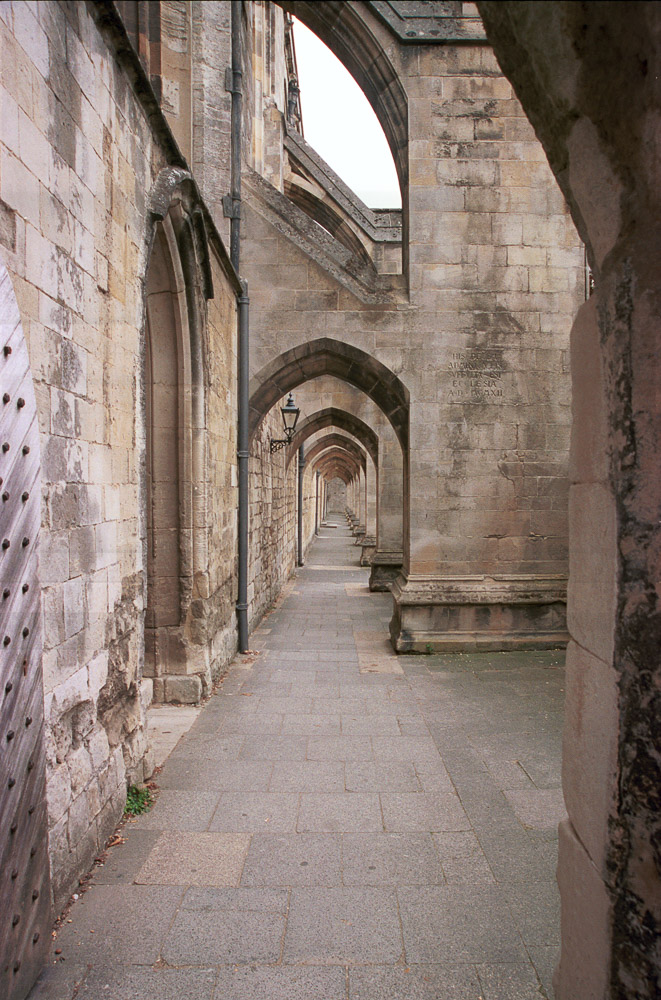
    Gothic cathedral repeating forms© Ed Schlotzhauer

    How to achieve it

    Flow is generally something that happens when we are completely immersed in a task that engages and energizes us. It seldom works to say “I’m going to go get into a flow state.”

    As an example, some of the researchers studying the theory studied jazz guitarists. They instrumented them and recorded their brain activity during improvisation sessions. At a high level summary, less experienced musicians had to concentrate hard on what they were doing and did not enter flow states. Experienced musicians tended to go into “automatic”. They concentrated on the sensory aspects of playing the guitar and little time thinking about what to do or how to improvise. They had a low level of DMN and ECN activity. This seems to support the expertise theory.

    That’s a lot of theory, but it doesn’t say much about how to achieve flow. You have to be expert in the task you are doing, and you have to have a extensive base of practice. Putting yourself in an environment where you are not distracted or interrupted helps, at least until the flow really kicks in. And being the type of person who is curious and self-driven and intuitive with a good ability to concentrate certainly seems to help a lot.

    Does it relate to art?

    I believe it is as common and valuable for artists as for jazz musicians or software engineers.

    Let’s re-examine the qualities I mentioned above for who gets into flow. Aren’t artists generally curious and self-driven and intuitive and with a good ability to concentrate? Don’t we have an intense desire, even need, to create? Aren’t we independent and self-reliant?

    We are prime to be able to find flows! The other missing piece is expertise and practice.

    This is one reason I recommend that we need to study to become expert in our craft. Using our tools should be fluid and natural. Exposure and depth of field and shutter speed and mechanics of using our camera should be automatic. This frees up our conscious attention for exploring composition and framing and expressing out feelings.

    And practice, practice, practice. Shoot frequently, daily if possible. Shoot something, anything. It’s OK to throw them away. The practice is worth is. All that practice is building the equivalent of muscle memory. Your fingers just know how to make the adjustments. Can you take out your camera in complete darkness and turn it on and set it up? Practice.

    When you go out to shoot, immerse yourself in the experience. Concentrate fully on what you are doing. Let the rest of the world fade away. If you are lucky, you will find afterwards that you were in flow. Whether or not you were, do your work. Plunge yourself into your art.

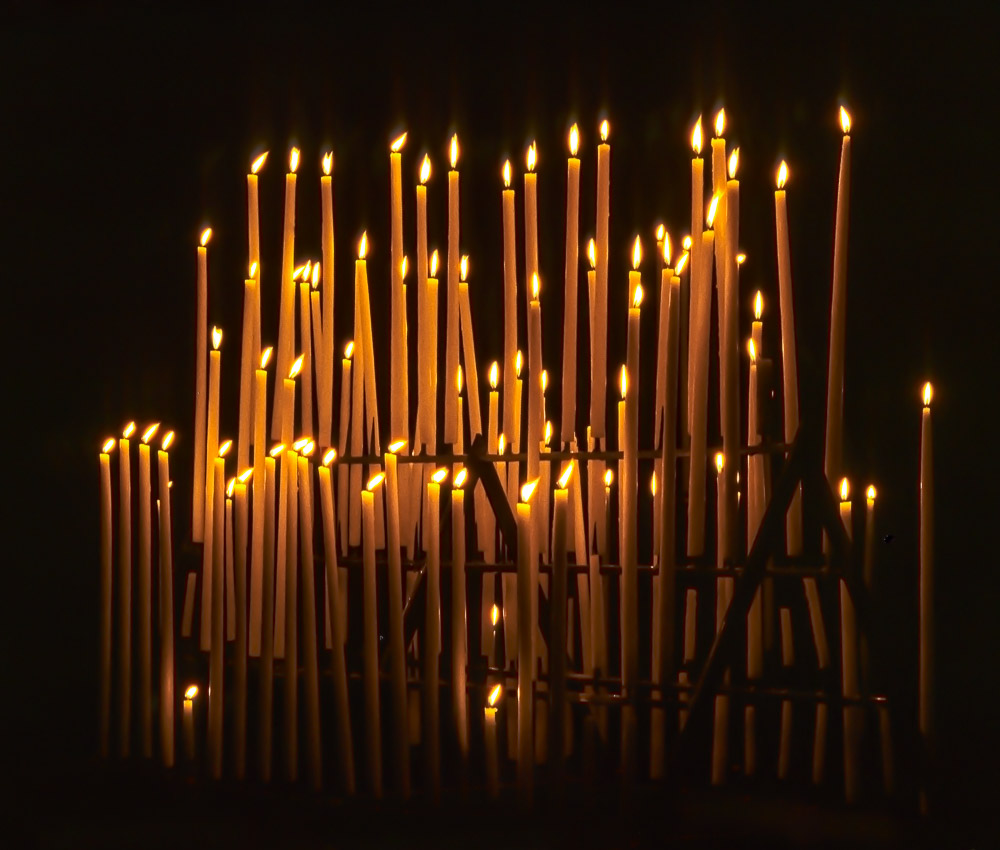
    Candles in a church© Ed Schlotzhauer
    Chartres Cathedral

    It is a positive experience

    I have experienced it, many times. As a software developer, I experienced this strange and exciting feeling regularly, long before I ever heard the term. Sometimes I would realize that hours have vanished and I forgot to eat lunch. And the productivity of what I did in those sessions was astounding. It was great to finally hear it described and find out I wasn’t crazy.

    As an artist it seems to happen different. I seldom work a scene for hours, although I may spend hours in a post processing session. But I may spend significant time wandering and looking and being immersed in the thought process. I believe this is a kind of flow. It seems to have the same result, where creativity flows easily and effortlessly. And it can produce a set of images that are above the norm of what I would expect.

    Even writing articles like this can achieve a flow state. I sometimes open a blog intending to make a few notes and jot down some thoughts I had, and realize a few hours later that I have nearly crafted a complete article. And I sometimes read through it and think “wow, did I write that?” 🙂

    A result

    Being in a flow is joyful. It is a happy state. But it is a result, not the goal. A flow state indicates that we have become completely immersed in a task that engages and energizes us. One that we are expert in and practiced enough in that we can sort of let go and let it happen. Kind of like those jazz guitarists they studied doing improvisations. It is not easy, it requires major commitment. But it is worth it.

    So study your craft. Gain deep knowledge and experience. Be familiar with ideas from other artists. Practice constantly (10,000 hour rule?). These will make you a better and more creative artist.

    Maybe, someday, you will look back on a block of creative energy you have just spent and think, that was probably a flow state. It feels great. Enjoy! Remember, Csikszentmihalyi discovered the idea of flow because he was researching happiness.

    Note

    I found 2 different rationale for calling it “flow”. One was that in Csikszentmihalyi’s interviews it was common for people to describe what was happening as “their work simply flowed out of them without much effort.” Another description says people sometimes described it as like being in a river flow. They were swept along with little effort.

    Decide what to call it when you experience it yourself.

  • How Not to be Creative

    How Not to be Creative

    You can find suggestions everywhere about how to be creative. I decided to turn it around and offer suggestions on how not to be creative. Is that creative? 🙂 I can’t guarantee that doing the opposite will make you creative, but perhaps they may be warning signs for consideration.

    Creativity

    We all want to be creative (I hope). But what it is? How do you define it?

    We all have different views and expectations. For photography, maybe it comes down to making images that seem fresh and “different” in a good way. They say that everything has been photographed. I don’t buy that. But even if it has, there are new viewpoints or treatments or lighting on our subjects. And there are still lots of things no one has thought to photograph.

    Few of us will create wholly new art genres the world has never seen. Few of us really want to. But we can do work that people look at, come back to, and admire as a whole new way of seeing a subject. We can project our feelings onto the print, giving it our unique stamp.

    We often use the metaphor of the muse inspiring us to creativity. If the muse is with us we are creative. If she is not, we can’t seem to do fresh work. Yes, our creative inspiration seems to come and go; to have highs and lows. I do not believe some imaginary Greek goddesses actually have anything to do with it. It is really happening within us.

    So rather than chasing after creativity, I want to look at ways to stifle the creativity we have.

    Distraction

    If you live in the Western world, you are probably paralyzed by distractions. Our devices and entertainment rather successfully compete for all of our time and mental bandwidth.

    People open their phones dozens of times a day because of fear of missing out (FOMO). We are expected to be online and available to our employers 24/7, even when on vacation. The wonders of the internet has opened up far too many “opportunities” to spend our time and attention.

    But rather than being an incredibly empowering technological aid to us, it has become the master we are slaves to. People are online at work all day then spend many hours at home doom scrolling funny cat videos or new dance moves or movies we don’t really care about.

    So, a great way to subvert your creativity is to be so distracted we do not have time for original thought. Creativity requires quiet time and very limited distractions. In general, the more attention we give our phones and other devices, the less opportunity to be creative we have.

    The technology is not bad in itself. I have 1G fiber and i would not want to let go of it. What we do with it is where we can hurt ourselves.

    Stress

    Another great creativity killer is stress. Stress focuses all of our attention on the problems we are facing.

    The world always tries to keep us treading water. Just a couple of days ago my fuel pump went out, while we were driving in a hard to access location in the mountains. Do you know how long it takes and what it costs to get your car towed over Trail Ridge Road in Rocky Mountain National Park? And do you know what it costs to replace a fuel pump? That can peak your blood pressure.

    That’s just one little example. All of us deal with many sources of stress all the time. It comes with life.

    Like our devices, stress occupies all of our attention if we let it. When we are stressed and worrying, we are seldom thinking creative thoughts. It seems more survival mode.

    So, to kill creativity, give in to worrying about stress. Fixate on those problems. Live with a survival mentality.

    Of course, we can’t just wish our stressors away. We need to deal with them. How we deal with them is up to us. Attitude is a big deal.

    Trying too hard

    Want to chase away the muse? Trying too hard is a good way.

    We should always be trying hard. What I mean, though, is trying to force our self to create something on our schedule. Just sitting there saying “I have to create something; now; do it; right now”. How does that work for you?

    Maybe it works better for you than it does for me. If I try to force myself to be creative it seems to have the opposite effect. I am a total blank.

    Actually, I can often lure creativity to visit me by ignoring it and thinking about or working on something else. I believe artistic creativity comes from the subconscious. Our minds need to be occupied with something not too demanding so our subconscious can be free to wander and think new thoughts. But then we must be conscious enough to realize what just happened and capture the idea.

    Too busy

    Another good way to not be creative is to be too busy. Busy with demanding tasks that occupy all our attention and mental bandwidth.

    The world around us encourages a high level of busyness. What do you say when someone greets you? “How ‘ya doing?” “Man, I’m staying really busy!” It’s almost a badge of honor.

    Being busy is much better than being idle. But like most things, when taken to an extreme, it can be destructive.

    If you are one of those super busy people with a full calendar, how do you find time to be creative? Maybe it is as simple as doing some prioritization and putting some blocks of time in your calendar where you will let your mind relax and give yourself the space to focus on your art.

    Imitation

    The last creativity killer I want to talk about is imitation. Are you trying to make art like your mentor or favorite artist?

    I believe this is a trap because we cannot be them. We can make work that looks a lot like theirs. But this is looking backward at what they have done in the past. We cannot be in their mind and have the same thoughts and influences that will guide them to new work. So all we can really do is copy them. That is not creative. We are not adding anything new.

    Can we learn from other artists? Of course! That is how advancements are made. The critic Lionel Trilling is quoted as saying “Immature artists imitate. Mature artists steal.” Many others have said similar things in slightly different ways. The consistent point made is that we take what we can learn from others and add it to our own art. Just imitating them, though, is a dead end.

    Conclusion

    Creativity is something we all have in varying amounts. It is an enabler and motivation of being an artist. But we are surrounded by many powerful forces that want to stifle our creativity.

    All the creativity sucking problems I list here are real and probably attack most of us most days. They are easy to identify but very hard to overcome.

    We cannot just pretend they are not there. Instead, we have to be very aware of them and actively work to fight them. If we don’t, we will be sucked into their trap and our art will never be seen. The path of least resistance is to give in and let our creativity be choked out.

    Fight!